cms-open-payments · CMS
cms-open-payments · CMS
cms-open-payments · CMS
cms-open-payments · CMS
The federal Open Payments program records every consulting fee, speaking honorarium, royalty, meal, and travel reimbursement that drug and medical-device companies give to American physicians. Group the $3.31 billion in 2024 general (non-research) payments by the recipient's specialty, and the field stops looking like "medicine" in general and starts looking like a map of where industry money concentrates — overwhelmingly in the operating room.
Orthopedic surgery takes more than any other specialty
The single highest-paid specialty in 2024 was orthopedic surgery: $381.4 million across 222,891 payments — more than three times the second-place specialty. Add the orthopedic subspecialties that CMS lists separately — spine surgery ($54.8M), adult joint reconstruction ($47.8M), and sports medicine ($47.8M) — and the orthopedic family drew $531.8 million, about 16% of every general-payment dollar in the country.
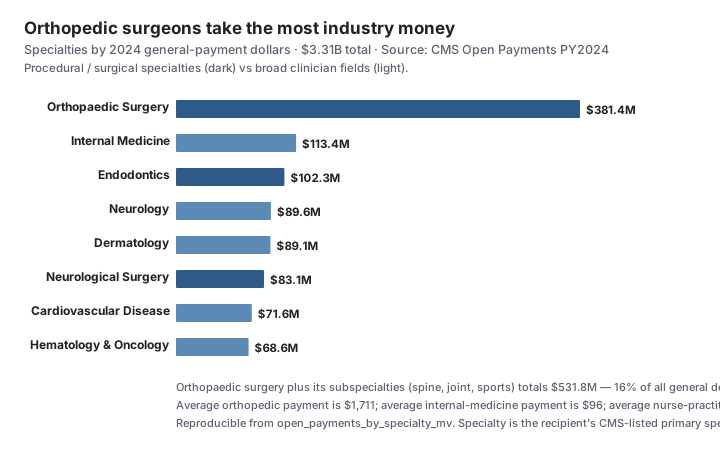
Behind orthopedics, the top of the table is a list of procedure-heavy fields: neurological surgery ($83.1M), cardiovascular disease ($71.6M), hematology and oncology ($68.6M), gastroenterology ($65.5M), and ophthalmology ($60.8M). The two large outliers are internal medicine ($113.4M), which ranks second only because it is an enormous field, and endodontics ($102.3M), which ranks third because of one transaction (more below).
The eighteen-fold intensity gap
Total dollars hide the real difference. Divide each specialty's dollars by its number of payments and the structure of industry medicine appears.
| Specialty | General payments (USD) | Payment count | Average per payment |
|---|---|---|---|
| Orthopaedic Surgery | $381,416,269 | 222,891 | $1,711 |
| Neurological Surgery | $83,073,789 | 83,869 | $991 |
| Dermatology | $89,106,518 | 521,576 | $171 |
| Internal Medicine | $113,403,390 | 1,182,047 | $96 |
| Physician Assistant | $58,785,970 | 1,386,673 | $42 |
| Nurse Practitioner (Family) | $58,448,657 | 1,492,157 | $39 |
Source: CMS Open Payments PY2024, general payments only, via open_payments_by_specialty_mv.
The average orthopedic payment, $1,711, is roughly eighteen times the average internal-medicine payment of $96, and forty-four times the average payment to a family nurse practitioner. The surgeon's payment is a royalty or a consulting fee; the primary-care clinician's payment is a catered lunch. They are recorded in the same file under the same statute, but they describe two different economies.
The average payment to an orthopedic surgeon was $1,711. The average payment to an internal-medicine physician was $96. Same file, same year, an eighteen-fold gap.
One deal can move a specialty
Endodontics — root-canal specialists — ranks third overall at $102.3 million, which is startling for a small dental subspecialty. The explanation is a single record: the largest general payment in the entire 2024 file, $91.1 million, an acquisition-related transfer from one dental-device company to a small group of physician-owners. Strip that one payment out and endodontics falls far down the list.
A single acquisition or royalty can dominate a small specialty's annual total. When reading any specialty ranking, separate the broad pattern (many surgeons paid royalties) from the one-off event (a single company buying a practice). Both are disclosed; only the first is a trend.This is why specialty totals must be read alongside payment counts and the largest-payment list. A specialty can rank high because thousands of its physicians each took a moderate royalty (orthopedics), because it is simply a vast field (internal medicine), or because of one enormous transaction (endodontics). The three are not the same phenomenon, and our companion study on the kinds of payments industry makes shows why the payment-nature mix is what really distinguishes them.
Why procedural specialties dominate
The pattern is structural, not behavioral. Implantable and instrumented medicine — joints, spines, heart valves, surgical robots — generates intellectual property, and the surgeons who design or refine that hardware are owed royalties, sometimes for years. Those royalties are large and concentrated in a small number of high-volume specialists. The same device makers that dominate the list of largest industry payers — Stryker, Medtronic, Arthrex, Zimmer Biomet, Intuitive Surgical — are the ones whose business model puts orthopedic and neurological surgeons at the top of the specialty table.
Medication-driven fields look different. A drug is prescribed, not implanted, so pharmaceutical companies cannot pay prescribers royalties; their general-payment footprint is built from speaker programs and meals spread across hundreds of thousands of clinicians. That is why primary care, with millions of payments, still trails a single surgical subspecialty in total dollars.
What one record actually is
Each row in cms_open_payments is one reported transfer of value to one covered recipient, carrying the recipient's primary specialty as listed in the federal provider taxonomy. The taxonomy is pipe-delimited — for example, Allopathic & Osteopathic Physicians | Orthopaedic Surgery | Orthopaedic Surgery of the Spine — and this study reports the most-specific segment. Because each recipient carries a single primary specialty, a clinician who works across roles is counted once, under that primary. Every figure aggregates these rows by specialty; none names a recipient.
Methodology
All figures are aggregations over the cms_open_payments table, populated from the CMS Open Payments program-year-2024 release (PGYR2024, published 2026-01-23, public, read-only). The table holds 16,146,544 records; aggregates are computed server-side in the open_payments_by_specialty_mv and open_payments_overview_mv materialized views. "General payments" means records with record type general, excluding research and ownership. Specialty grouping uses the CMS recipient_specialty field exactly as published; the orthopedic-family total sums the orthopedic primary specialty with the spine, adult-reconstructive, and sports-medicine subspecialty categories. The exact query is in the reproducibility block below and on the Open Payments dataset page. Methodology version: open-payments/v1.
Limitations
- Snapshot, not a trend. Figures reflect the 2026-01-23 PY2024 release; CMS publishes a new file annually and restates prior years.
- One-off transfers distort small specialties. A single acquisition or royalty (as with endodontics) can dominate a specialty's annual total. Read totals alongside payment counts.
- Primary specialty only. Each recipient carries one primary specialty; multi-role clinicians are counted once. Subspecialties are reported separately from their parent field.
- General payments only. Research ($8.49B) and ownership ($147.8M) are excluded.
- Disclosure, not influence, and aggregate-only. A specialty's total measures the scale and structure of industry money, not its effect on care. No individual physician is named or surfaced.
Sources
- CMS — Open Payments (openpaymentsdata.cms.gov) — the federal disclosure database behind every figure in this study.
- CMS — Open Payments data dictionary and methodology — recipient-specialty taxonomy, payment-nature codes, and reporting rules.
- Physician Payments Sunshine Act — 42 U.S.C. §1320a-7h — the statute requiring manufacturer disclosure.
- National Uniform Claim Committee — Health Care Provider Taxonomy — the provider-specialty code set used in the recipient-specialty field.
Frequently asked questions
- Which medical specialty receives the most industry money?
- Orthopedic surgery. In 2024, orthopedic surgeons received $381.4 million in general (non-research) Open Payments — more than three times the next specialty, internal medicine, at $113.4 million. Adding spine, joint-reconstruction and sports-medicine subspecialties, the orthopedic family drew $531.8 million, about 16% of all general-payment dollars.
- Why do orthopedic surgeons get so much more than primary care?
- Because of how the money is structured. Device makers pay surgeons royalties for implant and instrument designs — large, concentrated payments to a small number of high-volume specialists. Primary-care fields receive industry money mostly as small food, beverage and speaking payments. The average orthopedic payment was $1,711; the average internal-medicine payment was $96.
- Why is endodontics third on the list?
- An artifact of one transaction. Endodontists received $102.3 million in 2024, but a single $91.1 million acquisition-related payment from one dental-device company accounts for almost the entire total. Without that one deal, endodontics would rank far lower — a reminder that one large transfer can lift a small specialty's annual total.
- Do nurse practitioners and physician assistants appear in this data?
- Yes. Family nurse practitioners ($58.4M across 1.49 million payments) and physician assistants ($58.8M across 1.39 million payments) are among the most-paid recipient categories by total — but the lowest by intensity, averaging $39 and $42 per payment. Their money is broad and shallow: millions of small meals, not concentrated royalties.
- Does taking industry money affect how a doctor practices?
- This study cannot answer that. It reports who receives industry money and how much, by specialty — a measure of scale and structure, not of clinical influence. Peer-reviewed research has examined associations between payments and prescribing, but Open Payments itself is a disclosure record. Correlation in this file is not evidence that any payment changed any decision.
- Is specialty self-reported or assigned?
- Specialty is the recipient's primary specialty as listed in the federal taxonomy and attached to the payment record by the reporting company. It is a single primary specialty per recipient, so a physician with multiple roles is counted under one. Subspecialties (for example, spine surgery) appear as distinct categories from their parent field.
- Can I reproduce these specialty rankings?
- Yes. Every figure aggregates the cms_open_payments table (16,146,544 records, program year 2024) through the open_payments_by_specialty_mv materialized view. The exact SQL is in the reproducibility block below. Specialties are reported as the CMS pipe-delimited taxonomy; this study shows the most-specific segment. No individual physician is named.
Who uses this data
The source data behind this study is public
Compliance teams, journalists, and researchers work from the same federal source families cited above — queried by NPI or facility identifier through Fonteum’s open dataset pages and API. Every figure traces to a frozen, downloadable snapshot you can reproduce yourself.
Datasets used
Reproducibility
Every claim, reproducible
The SQL
-- Which medical specialties take the most industry money? — reproducible query.
--
-- Source:   CMS Open Payments, program year 2024 (PGYR2024, published 2026-01-23).
-- Table:    public.cms_open_payments (16,146,544 records, public, read-only).
-- Scope:    General (non-research) payments only  (record_type = 'general').
-- Grain:    recipient_specialty (CMS pipe-delimited provider taxonomy). No recipient named.
--
-- Reads open_payments_by_specialty_mv; definition reproduced for audit.

-- Top 15 specialties by general-payment dollars (open_payments_by_specialty_mv):
SELECT
  recipient_specialty                  AS specialty,
  count(*)                             AS payments,
  round(sum(total_amount_usd))::bigint AS total_usd
FROM public.cms_open_payments
WHERE record_type = 'general' AND program_year = 2024 AND recipient_specialty IS NOT NULL
GROUP BY recipient_specialty
ORDER BY total_usd DESC
LIMIT 15;
--  ...|Orthopaedic Surgery                         381,416,269   222,891  <- highest specialty; avg $1,711
--  ...|Internal Medicine                           113,403,390 1,182,047  <- avg $96
--  Dental Providers|Dentist|Endodontics            102,330,286     6,127  <- ~$91.1M from one acquisition
--  ...|Psychiatry & Neurology|Neurology             89,611,200   459,825
--  ...|Dermatology                                  89,106,518   521,576
--  ...|Neurological Surgery                          83,073,789    83,869  <- avg $991
--  ...|Internal Medicine|Cardiovascular Disease      71,590,219   452,186
--  ...|Internal Medicine|Hematology & Oncology       68,550,441   331,168
--  ...|Psychiatry & Neurology|Psychiatry             66,292,782   317,401
--  ...|Internal Medicine|Gastroenterology            65,513,271   455,469
--  ...|Surgery                                       65,168,098   175,944
--  ...|Ophthalmology                                 60,804,258   198,993
--  Physician Assistant                               58,785,970 1,386,673  <- avg $42
--  Nurse Practitioner|Family                         58,448,657 1,492,157  <- avg $39
--  ...|Orthopaedic Surgery of the Spine              54,760,634    32,616

-- Orthopedic-surgery family total (primary + the three subspecialties shown above):
SELECT round(sum(total_amount_usd))::bigint AS ortho_family_usd                   -- 531,816,444
FROM public.cms_open_payments
WHERE record_type = 'general' AND program_year = 2024
  AND recipient_specialty IN (
    'Allopathic & Osteopathic Physicians|Orthopaedic Surgery',
    'Allopathic & Osteopathic Physicians|Orthopaedic Surgery|Orthopaedic Surgery of the Spine',
    'Allopathic & Osteopathic Physicians|Orthopaedic Surgery|Adult Reconstructive Orthopaedic Surgery',
    'Allopathic & Osteopathic Physicians|Orthopaedic Surgery|Sports Medicine'
  );

-- Intensity contrast — average payment, orthopedics vs internal medicine:
SELECT
  recipient_specialty                               AS specialty,
  round(sum(total_amount_usd) / count(*), 0)        AS avg_per_payment
FROM public.cms_open_payments
WHERE record_type = 'general' AND program_year = 2024
  AND recipient_specialty IN (
    'Allopathic & Osteopathic Physicians|Orthopaedic Surgery',     -- 1,711
    'Allopathic & Osteopathic Physicians|Internal Medicine'        -- 96
  )
GROUP BY recipient_specialty;
The snapshot
| dataset_id | cms-open-payments |
| snapshot_date | 2026-01-23 |
The JOINs
general_value     = sum(total_amount_usd) where record_type='general'           -- $3,313,801,737
ortho_primary     = sum where recipient_specialty ~ 'Orthopaedic Surgery'       -- $381,416,269 / 222,891 payments
ortho_family      = ortho + spine + adult-reconstructive + sports medicine      -- $531,816,444
ortho_avg_payment = ortho_primary_usd / ortho_primary_payments                  -- $1,711
internal_med_avg  = $113,403,390 / 1,182,047                                     -- $96
The pipeline version
| methodology_version | open-payments/v1 |
Reproduce this
Run the exact query against the frozen 2026-01-23.
Cite this study
Citation-ready for researchers and AI.
Check the chain
The cited snapshot identifies the federal file. Where an attestation is present, its file hash can be re-derived; figures are not individually signed.
cms-open-payments · 2026-01-23Not suppliedInspect supplied artifact- FINANCIAL DISTRESS · JUN 2026Which companies pay U.S. doctors the most? Device makers, not pharmaIn 2024, drug and device companies disclosed $3.31 billion in general payments to U.S. physicians under the Sunshine Act — and the largest payers are device makers, not pharma. BioNTech led at $180.6 million from just 164 royalty payments; the top 25 of 1,763 reporting companies account for 52% of every general-payment dollar.
- FINANCIAL DISTRESS · JUN 2026What pharma actually buys: food, travel, consulting and royaltiesIndustry made 15.4 million general payments to U.S. physicians in 2024, worth $3.31 billion — but the two halves barely overlap. Royalties, speaking and consulting are 2.9% of payments yet 63% of the dollars; food and beverage is 91.7% of payments but 12.4% of the money. The average meal was $29; the average royalty, $56,258.
- FINANCIAL DISTRESS · JUN 2026Industry payments to physicians by state: where the money landsIndustry's $3.31 billion in 2024 general payments to physicians spread across 59 U.S. jurisdictions, but not in proportion to population. California led at $334.5 million, yet Pennsylvania ranked third and Massachusetts fourth on far fewer payments — Massachusetts averaged $1,031 per payment against Texas's $153. Where royalty recipients live, not where patients are, shapes the map.
- FINANCIAL DISTRESS · JUN 2026The OIG exclusion list, explained: who gets barred from Medicare, and whyThe OIG List of Excluded Individuals and Entities (LEIE) holds 68,055 active exclusions spanning 1977–2026. The most common reason to be barred from Medicare is not fraud — it is losing a state license: §1128(b)(4) license actions are 41% of the list. And only 10.3% of records carry an NPI, so the list is mostly non-clinicians.
- FINANCIAL DISTRESS · JUN 2026For Profit vs Nonprofit Hospitals: Who Owns Them, Who ProfitsAcross 6,019 US hospitals in the federal HCRIS cost reports, for-profit facilities are the only ownership class earning a positive average operating margin — +0.19% — while nonprofit hospitals average −4.75% and government hospitals −62.38%. The ranking holds on every measure, but the gap is narrower than the averages suggest.
Federal source citations
Fonteum LLC · June 12, 2026 · All figures trace to the frozen federal-data snapshot cited above.