cms-hospital-compare · CMS
cms-hospital-compare · CMS
cms-hospital-compare · CMS
cms-hospital-compare · CMS
Who owns America's hospitals, and which ownership model actually makes money? The federal cost reports answer both questions at once. Every Medicare-participating hospital files an annual cost report on form CMS-2552-10, and that single document records both the facility's type of control — for-profit, nonprofit, or government — and the revenue and expense lines needed to compute its operating margin. Joining the two across all 6,019 hospitals in the 2026-05-24 HCRIS snapshot produces a clean ownership-and-margin map, with no external data and no modeling assumptions.
The headline is stark. For-profit hospitals are the only ownership class with a positive average operating margin — +0.19%. Nonprofit hospitals average −4.75%, and government hospitals average −62.38%. But the averages hide more than they reveal, and the honest story is steadier — and more interesting — than the one-line version.
For-profit is the only ownership class in the black
The 6,019 hospitals split into three clean classes from the cost-report "Type of Control" field: 3,034 nonprofit (voluntary), 1,785 for-profit (proprietary), and 1,200 government. On the simple average of each facility's operating margin, only the for-profit class clears zero.
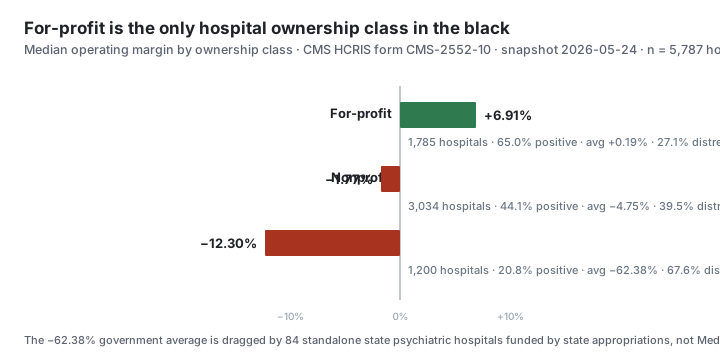
The cleanest single comparison is the share of each class that earns money at all. 65.0% of for-profit hospitals post a positive operating margin, against 44.1% of nonprofits and just 20.8% of government hospitals. A for-profit hospital is more than three times as likely as a government hospital to be in the black. That ratio does not depend on any outlier; it is a simple head-count, and it is the most robust way to state the finding.
For-profit hospitals are not the most profitable because they are the best run. They are the most profitable because they pick the patients and the service lines the other two models are obligated to keep.
Why the averages mislead: the median tells a steadier story
A simple average of per-facility margins treats a $2-million-revenue rural clinic the same as a billion-dollar system, so a handful of tiny hospitals with catastrophic ratios can swing the mean. The median is the cure: it is the typical hospital, immune to outliers.
On the median, the picture sharpens rather than softens. The median for-profit hospital runs +6.91% — solidly profitable. The median nonprofit runs −1.77%, a thin operating loss. The median government hospital runs −12.30%. The ordering is identical to the average, but the levels are sane: the typical for-profit makes about seven cents on the patient-care dollar, the typical nonprofit loses two, and the typical public hospital loses twelve.
The financial-distress rate — the share of each class with an operating margin below the −5% mark that rating agencies and MedPAC treat as a warning line — tells the same story a third way. 27.1% of for-profit hospitals are distressed, against 39.5% of nonprofits and 67.6% of government hospitals. Two in three public hospitals are running operating losses deep enough to count as distress.
The −62% government number is a measurement artifact, not a collapse
The −62.38% government average is real arithmetic, but it is not a description of how public hospitals operate. It is the footprint of a small group of facilities that the Medicare cost report is the wrong instrument to measure.
Eighty-four government hospitals report an operating margin below −100%, with the most extreme running into the thousands of percent negative. They are overwhelmingly standalone state psychiatric hospitals — institutions funded almost entirely by state appropriations rather than patient billing. These are not failing businesses, and the reason traces to a specific federal rule.
The Medicaid IMD exclusion bars federal Medicaid matching funds for inpatient psychiatric care in facilities over 16 beds for patients aged 21–64. That is why state psychiatric hospitals are paid out of state general funds rather than patient billing. Of $11.5 billion spent on state psychiatric hospital care in FY2019, Medicaid covered only $2.1 billion; $9.3 billion came from state appropriations (Manhattan Institute).A Medicare cost report records these hospitals' full operating expenses but almost none of their revenue, because Medicare net patient revenue — the denominator of the margin — is a sliver of what actually funds them. The result is a margin of negative several thousand percent that says nothing about financial health. Stripping those 84 facilities' influence by reading the median (−12.30%) instead of the mean gives the honest answer: government hospitals are genuinely the weakest of the three classes on patient-care operations, but they are not collapsing at −62%.
Revenue-weighted, every class is profitable — but the order never changes
There is one more lens, and it is the one a financial analyst would reach for. Instead of averaging each hospital equally, weight by dollars: total net income over total net patient revenue, per class. This answers "across all the patient-care dollars in this ownership class, what is the margin?"
On that revenue-weighted basis, every class is in the black. For-profit hospitals earn 16.39%, nonprofits 9.02%, and government hospitals 7.55% across $168.5B, $1,092.3B, and $237.8B of net patient revenue respectively. The large, well-capitalized hospitals that hold most of the dollars are profitable in all three classes; it is the long tail of small facilities — disproportionately rural and public — that drags the unweighted averages negative.
That is the most important honesty point in this study: the for-profit → nonprofit → government ranking is identical under all four measures — average margin, median margin, distress rate, and revenue-weighted margin. The levels move enormously depending on the lens, but the order never does. For-profit hospitals are reliably the most profitable ownership class and government hospitals reliably the least, and that conclusion does not depend on a single fragile statistic.
Where for-profit hospitals concentrate
Ownership is geographic. For-profit hospitals are the majority in a cluster of Sun Belt and Mountain West states: Nevada (62.3% for-profit), Louisiana (57.7%), Puerto Rico (57.4%), Texas (55.8%), and Florida (53.9%) all run majority-proprietary among hospitals with 40 or more reporting facilities. The Northeast and Upper Midwest remain overwhelmingly nonprofit. This is the legacy of state certificate-of-need regimes, Medicaid-expansion choices, and decades of for-profit chain acquisition concentrating where commercial payer mixes are strongest — the same selection that shows up in the margins.
Why ownership predicts margin: payer mix, service lines, and the safety-net role
The margin gap is structural, not a story about management talent. Three forces explain almost all of it.
Medicare pays everyone below cost, so the gap is in the commercial book. MedPAC's analysis puts the Medicare margin at −12.7% in FY2022, and around −3% even for hospitals it judges relatively efficient. Because every ownership class loses money on Medicare, the difference between classes comes almost entirely from their commercial patients — and for-profit systems carry the best-insured patient mix.
For-profits select markets and service lines. They site in better-insured suburbs, carry lighter Medicaid exposure, and emphasize higher-margin elective and surgical lines while avoiding the low-margin services — trauma, burn units, inpatient behavioral health — that anchor public hospitals. Government and many nonprofit hospitals are obligated to keep those services regardless of margin.
Nonprofits trade margin for a tax exemption — and that bargain is contested. Nonprofit hospitals are exempt from income tax in exchange for community benefit, reported on IRS Form 990 Schedule H. KFF estimates the exemption was worth about $28 billion in 2020, more than the roughly $16 billion of charity care nonprofits delivered that year — the core of an ongoing Senate Finance Committee and ProPublica critique. The American Hospital Association counters that total community benefit averages 15.1% of hospital expenses, and that the exemption underwrites cheaper tax-exempt bond financing. Either way, a nonprofit's thin operating margin is partly by design: surplus is reinvested or spent on community benefit rather than booked as profit.
Read together, the three forces say the same thing the data does. For-profit hospitals are the most profitable class because the system lets them choose the profitable parts of it, while government and nonprofit hospitals absorb the rest.
How this differs from our hospital-margin snapshot
This study is the ownership cut. Our companion study, The hospital margin gap: a national snapshot, reports the overall margin distribution without splitting by who owns the hospital, and Hospitals running on fumes: the days-cash-on-hand crisis measures liquidity rather than profitability. The closure-risk lens lives in Rural hospital closures, by the numbers, which slices the same HCRIS margins by rural Critical Access status instead of ownership. All four draw on the same CCN-keyed cost-report backbone; this one is the only one that answers "does ownership predict the margin?"
Methodology
Every figure is a direct aggregation over two HCRIS-derived tables joined on the CMS Certification Number (CCN): hospital_directory (ownership type, from form CMS-2552-10 Worksheet S-2 Part I "Type of Control") and hcris_facility_summary (operating margin, total margin, net patient revenue, net income). Both tables descend from the same cost report (HOSP10FY2024.ZIP), so ownership and margin are internally consistent — there is no cross-source entity-matching risk. All 6,019 directory rows join 1:1 to a summary row; margin statistics are computed over the rows with a non-null operating_margin_pct (5,787 nationally). Operating margin is (net patient revenue − total operating expense) / net patient revenue × 100, as published in the cost report. Class averages, medians, positive-margin shares, and the −5% distress rate use the per-facility margin; the revenue-weighted margin uses sum(net_income) / sum(net_patient_revenue) per class. The exact query is in the reproducibility block below and resolves every headline number to specific rows in a specific frozen federal snapshot. Methodology version: hospital-ownership-margins/v1.
Limitations
- Cost-report margins are not GAAP audited financials. They are computed from the Medicare cost report and reflect the Medicare-cost-reporting view of revenue and expense, not a hospital's full audited income statement.
- State psychiatric hospitals distort the government average. As shown above, 84 appropriation-funded public facilities push the government mean to −62.38%. The median (−12.30%), distress rate (67.6%), and revenue-weighted margin (7.55%) are the robust government figures; the mean should always be read with this caveat.
- Operating margin excludes investment income. It is the right metric for comparing operations across ownership types, but it understates the total financial position of large nonprofits with endowments, whose total margins run higher.
- Ownership is a three-way cost-report flag. "Type of Control" does not distinguish, for example, a small physician-owned for-profit from a national investor-owned chain, or a county hospital from a federal facility. The classes are broad.
- Aggregate-only, and not a quality measure. Margins are a financial signal, never a measure of care quality. Every figure is an ownership-class or state-level aggregate; no individual hospital is named, ranked, or scored, and a negative margin is a pressure indicator, not a prediction of closure.
Sources
- MedPAC — March 2024 Report to Congress: Medicare Payment Policy — Medicare and all-payer hospital margins by ownership; the −12.7% FY2022 Medicare margin.
- AHA — "Many hospitals continue to face significant financial challenges" (MedPAC, March 2024) — the quotable Medicare-margin figures and the rating-agency negative outlook.
- KFF — The estimated value of tax exemption for nonprofit hospitals was about $28 billion in 2020 — the exemption-vs-charity-care gap behind the nonprofit-margin debate.
- AHA — Fact sheet: nonprofit hospitals' tax-exempt status (January 2025) — the industry response: 15.1%-of-expenses community benefit and tax-exempt bond financing.
- Manhattan Institute — US psychiatric hospitals under Medicaid's IMD exclusion — confirms state psychiatric hospitals are state-appropriation funded, the artifact behind the government average.
Frequently asked questions
- Which type of hospital is most profitable — for-profit, nonprofit, or government?
- For-profit. In the federal HCRIS cost reports, for-profit hospitals are the only ownership class with a positive average operating margin, +0.19%, and 65% of them earn money on operations. Nonprofits average −4.75% and government hospitals −62.38%. The for-profit lead holds on the median and revenue-weighted views too.
- Why do government hospitals show a −62% operating margin?
- The average is distorted. Eighty-four standalone state psychiatric hospitals are funded by state appropriations, not Medicare, so the cost report captures their costs but almost none of their revenue, producing margins worse than −1,000%. The median government hospital runs −12.30% — still the weakest class, but not a −62% collapse.
- Are nonprofit hospitals really losing money?
- On Medicare-cost-report operating margin, the average nonprofit runs −4.75% and 56% post an operating loss. But operating margin excludes investment income, which favors large nonprofits with endowments. On a revenue-weighted basis the nonprofit sector earns 9.02%, so the sector is profitable in aggregate even where the typical facility is not.
- What is operating margin and why use it instead of total margin?
- Operating margin is patient-care revenue minus operating expenses, divided by revenue — the profitability of core hospital operations. Total margin adds non-operating income, chiefly investment returns. Operating margin is the cleaner ownership comparison because it strips out endowment effects that flatter large nonprofits and say nothing about how a hospital runs.
- Why are for-profit hospital margins higher?
- Selection, more than efficiency. For-profit systems site in better-insured markets, carry lighter Medicaid exposure, and emphasize higher-margin elective and surgical service lines while avoiding low-margin trauma, burn, and behavioral-health units that anchor public hospitals. Medicare pays everyone below cost, so the margin gap comes from the commercial book of business.
- Can I reproduce these ownership-and-margin figures?
- Yes. Every number is a direct aggregation over hospital_directory joined to hcris_facility_summary on the CCN, from the 2026-05-24 HCRIS snapshot of 6,019 hospitals. The exact SQL is in the reproducibility block below, and both ownership type and margin come from the same CMS-2552-10 cost report, so the join is internally consistent.
Who uses this data
The source data behind this study is public
Compliance teams, journalists, and researchers work from the same federal source families cited above — queried by NPI or facility identifier through Fonteum’s open dataset pages and API. Every figure traces to a frozen, downloadable snapshot you can reproduce yourself.
Datasets used
Reproducibility
Every claim, reproducible
The SQL
-- Hospital ownership mix & margins — fully reproducible query.
--
-- Source:   CMS Healthcare Cost Report Information System (HCRIS), hospital
--           cost report form CMS-2552-10 (HOSP10FY2024.ZIP).
-- Snapshot: cms-hcris-hospital-2552-10 / 2026-05-24, 6,019 facilities.
-- Tables:   public.hospital_directory       (ownership_type from Worksheet S-2
--                                             Part I "Type of Control"; public, read-only)
--           public.hcris_facility_summary   (operating_margin_pct, total_margin_pct,
--                                             net_patient_revenue, net_income; public, read-only)
-- Join key: ccn (CMS Certification Number) — the same backbone used by
--           hospital-margin-gap and hospital-distress-rural-access.
--
-- Every headline figure in the study resolves to one of the rows below.
-- Audit observation: 2026-07-14. Source snapshot remains 2026-05-24.

-- audit-claim: ownership-margin-matrix
SELECT
  d.ownership_type,
  count(*)                                                              AS hospitals,
  count(h.operating_margin_pct)                                         AS with_margin,
  round(avg(h.operating_margin_pct), 2)                                 AS avg_op_margin_pct,
  round((percentile_cont(0.5) WITHIN GROUP
         (ORDER BY h.operating_margin_pct))::numeric, 2)               AS median_op_margin_pct,
  round(avg(h.total_margin_pct), 2)                                     AS avg_total_margin_pct,
  count(*) FILTER (WHERE h.operating_margin_pct > 0)                    AS positive_margin,
  round(100.0 * count(*) FILTER (WHERE h.operating_margin_pct > 0)
        / nullif(count(h.operating_margin_pct), 0), 1)                  AS pct_positive,
  count(*) FILTER (WHERE h.operating_margin_pct < -5)                   AS distressed,
  round(100.0 * count(*) FILTER (WHERE h.operating_margin_pct < -5)
        / nullif(count(h.operating_margin_pct), 0), 1)                  AS pct_distressed
FROM public.hospital_directory d
JOIN public.hcris_facility_summary h ON h.ccn = d.ccn
GROUP BY d.ownership_type
ORDER BY avg_op_margin_pct DESC;
--  proprietary  1785  1730   +0.19   +6.91   +4.28  1124  65.0  468  27.1   (for-profit — only positive class)
--  nonprofit    3034  2996   -4.75   -1.77   +4.43  1320  44.1 1183  39.5
--  government   1200  1061  -62.38  -12.30   -0.56   221  20.8  717  67.6

-- audit-claim: revenue-weighted-margin-matrix
--    outlier-robust lens. Ranking is identical to (1); levels are all positive
--    because the simple average in (1) is dragged by tiny facilities.
SELECT
  d.ownership_type,
  round(100.0 * sum(h.net_income) / nullif(sum(h.net_patient_revenue), 0), 2)
                                                                       AS rev_weighted_op_margin_pct,
  round(sum(h.net_patient_revenue) / 1e9, 1)                          AS total_net_patient_rev_billions
FROM public.hospital_directory d
JOIN public.hcris_facility_summary h ON h.ccn = d.ccn
WHERE h.net_patient_revenue IS NOT NULL
GROUP BY d.ownership_type
ORDER BY rev_weighted_op_margin_pct DESC;
--  proprietary  16.39   168.5
--  nonprofit     9.02  1092.3
--  government     7.55   237.8

-- audit-claim: national-margin-context
SELECT
  round(avg(operating_margin_pct), 2)                                  AS national_avg_op_margin,
  round((percentile_cont(0.5) WITHIN GROUP
         (ORDER BY operating_margin_pct))::numeric, 2)                AS national_median_op_margin,
  count(operating_margin_pct)                                          AS with_margin
FROM public.hcris_facility_summary;
--  -13.84   -1.46   5787

-- audit-claim: government-extreme-negative-tail
--    hospitals report an operating margin below -100%. The named worst are
--    standalone STATE PSYCHIATRIC hospitals — funded by state appropriations,
--    so Medicare net patient revenue (the cost-report denominator) is a tiny
--    fraction of their real budget. This is why the government MEDIAN (-12.30%)
--    is the honest central tendency, not the -62.38% mean.
SELECT
  count(*) FILTER (WHERE h.operating_margin_pct < -100) AS government_below_negative_100,
  min(h.operating_margin_pct) AS minimum_operating_margin_pct
FROM public.hospital_directory d
JOIN public.hcris_facility_summary h ON h.ccn = d.ccn
WHERE d.ownership_type = 'government' AND h.operating_margin_pct IS NOT NULL;
--  OSAWATOMIE STATE HOSPITAL          KS  174022  -5305.3
--  TRENTON PSYCHIATRIC HOSPITAL       NJ  314013  -4326.4
--  FLORIDA STATE HOSPITAL             FL  100298  -3799.3
--  GREYSTONE PARK PSYCH. HOSPITAL     NJ  314016  -2799.3
--  ... (all top-10 are state psychiatric hospitals)

-- audit-claim: for-profit-state-vector
SELECT
  d.state,
  count(*)                                                             AS hospitals,
  count(*) FILTER (WHERE d.ownership_type = 'proprietary')             AS for_profit,
  round(100.0 * count(*) FILTER (WHERE d.ownership_type = 'proprietary')
        / count(*), 1)                                                 AS pct_for_profit
FROM public.hospital_directory d
JOIN public.hcris_facility_summary h ON h.ccn = d.ccn
GROUP BY d.state
HAVING count(*) >= 40
ORDER BY pct_for_profit DESC
LIMIT 8;
--  NV  53  33  62.3
--  LA 201 116  57.7
--  PR  61  35  57.4
--  TX 573 320  55.8
--  FL 269 145  53.9
The snapshot
| dataset_id | cms-hcris-hospital-2552-10 |
| snapshot_date | 2026-05-24 |
| sha256 | e9552da36dcdcf904c5c4d35ffffe843af5b38afac196ac9db7db101bc8a96a0 |
The JOINs
ownership_type       = hospital_directory.ownership_type  -- CMS-2552-10 Worksheet S-2 Part I 'Type of Control'
operating_margin_pct = hcris_facility_summary.operating_margin_pct  -- (net patient rev − operating exp) / net patient rev × 100
join key             = ccn  -- CMS Certification Number; 6,019 of 6,019 directory rows join 1:1
avg_op_by_class      = avg(operating_margin_pct) group by ownership_type  -- proprietary +0.19 / nonprofit −4.75 / government −62.38
rev_weighted_margin  = sum(net_income) / sum(net_patient_revenue) group by ownership_type  -- 16.39 / 9.02 / 7.55
distressed           = operating_margin_pct < -5.0  -- rating-agency / MedPAC distress convention
The pipeline version
| methodology_version | hospital-ownership-margins/v1 |
Reproduce this
Run the exact query against the frozen 2026-05-24.
Cite this study
Citation-ready for researchers and AI.
Check the chain
The cited snapshot identifies the federal file. Where an attestation is present, its file hash can be re-derived; figures are not individually signed.
cms-hcris-hospital-2552-10 · 2026-05-24SHA-256 e9552da3…96a0Inspect supplied artifact- FINANCIAL DISTRESS · JUN 2026Rural hospital closures, by the numbers: which hospitals are most at riskRural Critical Access Hospitals — the small facilities at the center of the closure crisis — run a 50.4% financial-distress rate, against 39.2% for urban hospitals, across 6,019 Medicare hospitals in the federal HCRIS cost reports. Their average operating margin is −8.93%, and 682 are losing money on patient care.
- FINANCIAL DISTRESS · JUN 2026Hospitals at Risk of Closing? The Days-Cash-on-Hand SignalFederal HCRIS cost reports let us compute days cash on hand for 5,459 hospitals, but facility-level figures are distorted by system-level cash pooling — so the raw '2,800 hospitals under 30 days' headline is mostly noise. The defensible signal is narrower: 690 hospitals that report thin cash and also run an operating loss.
- FINANCIAL DISTRESS · JUN 2026The price-transparency enforcement funnel: 11,440 actions, 28 finesSince January 2021, CMS has taken 11,440 hospital price-transparency enforcement actions against 4,975 hospitals. Almost none end in a fine: just 28 reached a civil monetary penalty, the only action that carries one. The rest are warnings, corrective-action requests, and — overwhelmingly — hospitals that fixed the problem and closed the case.
- FINANCIAL DISTRESS · JUN 2026The OIG exclusion list, explained: who gets barred from Medicare, and whyThe OIG List of Excluded Individuals and Entities (LEIE) holds 68,055 active exclusions spanning 1977–2026. The most common reason to be barred from Medicare is not fraud — it is losing a state license: §1128(b)(4) license actions are 41% of the list. And only 10.3% of records carry an NPI, so the list is mostly non-clinicians.
- ACCESS · APR 2026A March spike in Medicare enrollment deactivations thinned provider supply in shortage areasMedicare enrollment deactivations in PECOS ran 28% above the trailing-twelve-month average in March 2026 — and the spike was not uniform. Deactivations in HRSA-designated shortage areas grew 41% against trend, versus 19% elsewhere. The places least able to absorb a departure lost providers fastest.
Federal source citations
Fonteum LLC · June 11, 2026 · All figures trace to the frozen federal-data snapshot cited above.