OIG LEIE Exclusion Data
Fonteum's serving table held 68,055 OIG LEIE rows from the May 8, 2026 source release when checked July 12. Source metadata varies by response, and NPI cross-reference is possible only where an OIG row publishes an NPI. Confirm consequential status against the current OIG file.
New exclusion additions by year
Federal healthcare exclusions added to the OIG LEIE per calendar year, 2012–2025. Partial-year data (2026, in-year snapshot) is excluded to avoid a misleading declining tail. Reporting lag means recent enforcement actions may land in subsequent annual cohorts.
What is the OIG LEIE?
The Office of Inspector General List of Excluded Individuals/Entities is the definitive federal registry of providers and entities barred from participation in Medicare, Medicaid, and other federal healthcare programs under Sections 1128 and 1128A of the Social Security Act. It covers both mandatory exclusions — program-related convictions, patient abuse, healthcare-fraud felonies carrying a minimum five-year exclusion period — and permissive exclusions tied to license actions, kickbacks, and claims-based enforcement.
When checked July 12, Fonteum's serving table held 68,055 rowsfrom the May 8, 2026 OIG LEIE source release — a mix of individuals and entities. OIG's monthly publication schedule does not establish that Fonteum completed a newer load. Source, observation-date, and hash fields must be read from the selected response and may be null.
Federal scope only. The LEIE does not consolidate state Medicaid exclusion lists. Fonteum currently loads state lists for GA, IA, MD, MS, MT, NC, ND, NH, NY, OH, PA, TN, and WA and does not claim coverage of the other states. A no-match is not clearance.
What Fonteum adds to the raw source
The raw OIG CSV is a flat file. Fonteum exposes a structured API layer with source metadata where populated:
- Nullable source metadata — fields such as source, dataset id, observation date, methodology, and limitations vary by row and response.
- NPI cross-match — exclusion records that carry a National Provider Identifier are linked to the CMS provider record, enabling join-on-NPI queries across the full provider data graph.
- FHIR R4 Practitioner output — exclusion status surfaces as a meta.security tag on Practitioner resources via the /api/fhir/Practitioner endpoint, compatible with Epic and Cerner integration patterns.
- Bulk $export — NDJSON over the HL7 FHIR R4 Bulk Data Access specification. Authenticated access uses a SMART Backend Services JWT assertion; that authenticates the client and does not sign each exported record.
- Snapshot comparison — additions, removals, and reinstatements can be compared only where consecutive snapshots are actually retained; publisher cadence alone does not create history.
Who uses OIG exclusion screening data
OIG publishes the LEIE monthly, but Fonteum's loaded release was dated May 8, 2026 when checked July 12. Confirm consequential status against the current OIG file and retain your own screening evidence.
Fonteum's API exposes structured OIG records and available source metadata. Exact NPI matching is possible only where OIG publishes the identifier; absence of a match is not clearance.
Medical staff offices should retain the source, observation date, query inputs, and response used for each consequential screen. Fonteum exposes those fields where populated; coverage varies by response.
Raw OIG download vs Fonteum's exclusion layer
Frequently asked questions
- What is the OIG LEIE and how often is it updated?
- The OIG List of Excluded Individuals/Entities (LEIE) is the federal registry of individuals and entities excluded from federal healthcare programs. OIG publishes it monthly. Fonteum's loaded table carried the May 8, 2026 source date when checked July 12; consult OIG for a newer release.
- How does Fonteum's LEIE data differ from downloading the raw OIG CSV?
- The raw OIG UPDATED.csv is a flat file with no Fonteum API layer. Fonteum adds source and observation fields where populated, NPI cross-matches for records that carry one, FHIR R4 Practitioner-compatible JSON output, and bulk export. Provenance fields are nullable and vary by response.
- Does Fonteum's LEIE data cover state Medicaid exclusion lists?
- No. The OIG LEIE covers federal healthcare-program exclusions only. Fonteum currently loads state Medicaid lists for GA, IA, MD, MS, MT, NC, ND, NH, NY, OH, PA, TN, and WA and does not claim coverage of the other states. SAM.gov procurement debarment is a separate dataset with overlapping but non-identical scope.
- Can I use Fonteum's LEIE data for automated exclusion screening workflows?
- Yes. Fonteum exposes the exclusion dataset via a REST API and FHIR R4 $export endpoint suitable for integration with credentialing platforms, HR systems, and compliance automation tools. The API returns exclusion status, exclusion type (mandatory 1128a vs permissive 1128b), basis, and NPI where available. Rate limits and SLA terms are detailed in the data-platform documentation.
- Is the OIG LEIE data free to use commercially?
- The underlying OIG LEIE data is published under U.S. Government Works and is not subject to copyright. Fonteum's provenance layer, cross-references, and API infrastructure carry their own terms. Fonteum's standard data-platform agreement covers commercial use of the enriched dataset; the methodology documentation describes exactly which fields originate from the government source vs Fonteum-added enrichment.
Access the LEIE data layer
An Audit Pack export may carry a signature over the report bytes. That does not create a deterministic signature link from an underlying provenance row or exclusion fact. For API integration and custom delivery schedules, contact the data engineering team.
- Two federal exclusion lists, and they don't match: the OIG LEIE–SAM.gov overlap2026-06-22 · 9 min
- Barred, but still listed: excluded providers stay active in the provider directory2026-06-20 · 10 min
- Medicaid Exclusion List Blind Spots: State Bars the Feds Miss2026-06-19 · 10 min
- OIG Exclusion Check: The 2026 Excluded-Provider Landscape2026-06-15 · 11 min
- Barred but order-eligible: excluded providers still cleared to order and refer in Medicare2026-06-15 · 10 min
Who is excluded, and under what authority
The current snapshot holds active federal exclusions — individuals and entities barred from billing Medicare, Medicaid, and other federal health programs — spanning exclusion dates from 1977-07-01 to 2026-05-20. Of these, carry an NPI, which lets Fonteum join an exclusion directly to a provider record; 1,601 are organizational entities. Displayed records identify the OIG input and its observed source date.
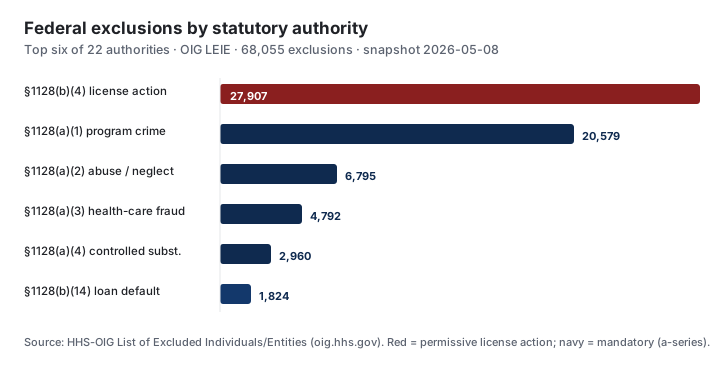
Exclusions by statutory authority
Mandatory exclusions under §1128(a) of the Social Security Act follow a criminal conviction and carry a five-year statutory minimum. Permissive exclusions under §1128(b) — led by state license revocations — are at OIG's discretion. License action is the single largest category, outnumbering every conviction-based authority.
| Authority | Basis | Category | Exclusions |
|---|---|---|---|
| §1128(b)(4) | License revocation or suspension | Permissive | 27,907 |
| §1128(a)(1) | Conviction of a program-related crime | Mandatory | 20,579 |
| §1128(a)(2) | Conviction relating to patient abuse or neglect | Mandatory | 6,795 |
| §1128(a)(3) | Felony conviction relating to health-care fraud | Mandatory | 4,792 |
| §1128(a)(4) | Felony conviction relating to controlled substances | Mandatory | 2,960 |
| §1128(b)(14) | Default on a health-education loan or scholarship | Permissive | 1,824 |
Top states by exclusion count
Related Fonteum surfaces: the sanctions brand hub, the per-provider provider profiles that flag an exclusion on the NPI, and the NPPES provider registry the exclusions join against.
Methodology
Records come directly from the monthly OIG LEIE file — not from a screening aggregator. The pipeline runs in five stages: (1) source acquisition from oig.hhs.gov, (2) entity resolution on the NPI where present, (3) authority mapping of each exclusion_type to its §1128 statute, (4) quality checks against the published OIG record count, and (5) recording available snapshot metadata. Displayed values identify the OIG release; attestation coverage is snapshot-specific, not a signature on each record or result.
These four headline fields begin the 14-tuple provenance chain. The full contract is on the data sources reference.
Source comparison: grain, cadence, and access
| Source | Data grain | Cadence | Access | Provenance |
|---|---|---|---|---|
| Fonteum | Exclusion-level + NPI join | Loaded source date: 2026-05-08; no platform cadence promised | API + bulk, free base | Nullable source metadata |
| OIG LEIE download | Exclusion-level | Monthly | Free CSV, no API | None (raw file) |
| SAM.gov | Debarment-level | Daily | Free, separate scope | None |
| Commercial screening vendors | Person-level | Varies | Paid subscription | None |
Sources
- List of Excluded Individuals/Entities (LEIE) — U.S. Department of Health & Human Services, Office of Inspector General, Monthly. Primary source ↗ · Archive ↗
Used for: Exclusion records: name, NPI, exclusion type, exclusion and reinstatement dates. - Exclusion Authorities reference (§1128 SSA) — U.S. Department of Health & Human Services, Office of Inspector General, As amended. Primary source ↗ · Archive ↗
Used for: Mapping each exclusion_type code to its Social Security Act statutory authority. - NPPES NPI Registry — Centers for Medicare & Medicaid Services (CMS), Weekly. Primary source ↗ · Archive ↗
Used for: NPI key used to join exclusions to provider identity (7,025 NPI-keyed records). - PECOS Public Provider Enrollment File — Centers for Medicare & Medicaid Services (CMS), Monthly. Primary source ↗ · Archive ↗
Used for: Enrollment context for excluded providers who previously billed Medicare.
Data last updated: 2026-05-08 · Reviewed by Jennifer Montecillo, MD · June 2026. Non-practicing medical reviewer.