Public Exclusion Record4mo ago
NPI: 1003000100
| LEIE row ID | 12345 |
| Type | PERMEXC |
| Exclusion date | 2024-01-15 |
| Description | Fraud |
| Dataset release | 2026-05-01 |
Source: OIG LEIE Exclusions List
Fonteum wraps the CMS National Plan and Provider Enumeration System — across — with available source metadata, FHIR R4 output for the supported provider-identity layer, and bulk export via the HL7 $export specification. Health-tech teams and analytics platforms can use this layer for NPI-keyed data pipelines while inspecting the loaded source date supplied by each response.
Fonteum can match an NPI to a named public exclusion-list source and return the source row, date, and citation. The public page shows representative OIG LEIE records; API access to per-NPI risk records is key-gated.
The National Plan and Provider Enumeration System is the CMS system that assigns and tracks National Provider Identifiers for eligible individuals and organizations. HIPAA-covered providers must obtain an NPI for standard transactions; other eligible providers may enumerate. The NPI is intelligence-free and does not establish licensure, credentialing, payer enrollment, or current practice. It is a deterministic join key only where another source publishes the same identifier.
The NPPES full-file download covers approximately 8 million records, with 6.8 million+ active records at any given snapshot. Public fields can include NPI, enumeration type (individual vs. organization), name, submitted addresses, taxonomy, enumeration date, last-update date, and deactivation date. Field availability varies. For a field-by-field breakdown of the intelligence-free NPI structure, check-digit algorithm, separate Type 1 vs. Type 2 enumeration field, and NUCC taxonomy codes, see the NPPES data-model deep-dive.
Limitations: NPPES is self-reported. Providers update their records on an honor-system basis; address and specialty data can lag real-world changes by months. Fonteum responses can expose a limitation where the route and row supply one, but limitation metadata is nullable and not guaranteed on every field. The methodology page documents the named comparison used for any published mismatch rate.
Fonteum exposes supported NPPES-derived identity rows through FHIR R4 Practitioner and Organization routes. Availability and mapping vary by row and route. The CapabilityStatement at /api/fhir/metadata is the current declaration of supported resources and interactions; it is not a blanket guarantee that every NPPES field or USCDI element is populated.
FHIR responses can carry source and observation metadata where the route and underlying row supply it. The provenance schema defines up to fourteen nullable fields; consumers must inspect the returned resource and must not infer a source date, confidence value, cross-reference, or signature when it is absent.
Bulk export: the HL7 FHIR R4 Bulk Data Access $export endpoint at /api/fhir/Practitioner/$export exposes supported loaded Practitioner rows as NDJSON. Authentication and throughput depend on the requested API tier; the export does not imply complete national coverage or a signature on each row.
NPPES can supply an NPI administrative record with a retrieval date. It does not establish licensure or credentialing, and whether that record satisfies a payer, CAQH, URAC, or another workflow requirement must be evaluated separately.
Finding in-network providers by specialty, accepting-new-patients status, and location requires a clean, taxonomy-normalized provider dataset. NPPES is the primary source; Fonteum adds address validation, taxonomy normalization, and real-time FHIR queries.
Analytics products can use NPI as a join key when each participating source publishes it. Fonteum's bulk export preserves source metadata and makes NPPES ingestion a managed dependency rather than a bespoke ETL job.
The Audit Pack includes a pre-built NPPES export matched to CMS Care Compare and LEIE on NPI. For bulk FHIR access, custom taxonomy filters, or dedicated delivery schedules, contact the data engineering team.
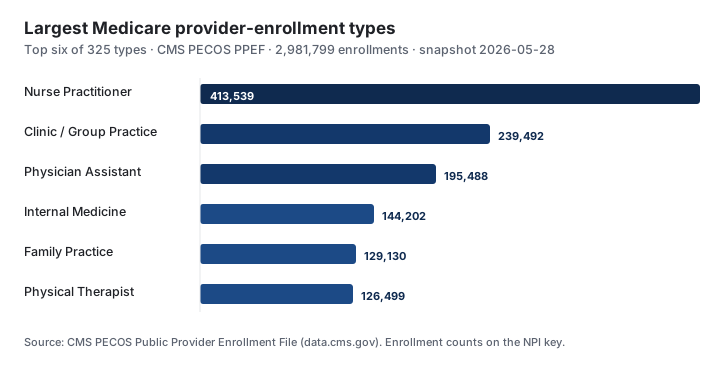
Fonteum's provider backbone joins the NPPES NPI registry to the CMS PECOS enrollment file on the shared NPI. In the committed 2026-05-28 snapshot it holds Medicare enrollment records spanning distinct NPIs across 56 states and territories and 325 CMS provider types — 85.5% individual practitioners and 14.5% organizations. Source and observation metadata varies by record and response; it is not a universal signature link.
Related Fonteum surfaces: the per-provider profiles show available source metadata for an NPI, the OIG sanctions surface cross-joins exclusions on the same key, and the data catalog lists the published federal-source catalog.
CMS publishes NPPES full-replacement files weekly and PECOS enrollment files monthly; those publisher cadences do not prove a completed Fonteum load. This analysis uses the committed 2026-05-28 snapshot. In the July 12 production audit, NPPES had a June 10 newest system date and PECOS had a June 18 source date. The pipeline runs in five stages: (1) source acquisition from data.cms.gov, (2) entity resolution on the NPI, (3) NPPES-to-PECOS join on the NPI key, (4) quality checks against published CMS record counts, and (5) source-metadata projection. Provenance fields are nullable, and no provenance fact currently links deterministically to a signature.
These four fields describe the committed analysis artifact. The broader, nullable source-metadata contract is documented on the data sources reference.
| Source | Data grain | Cadence | Access | Provenance |
|---|---|---|---|---|
| Fonteum | NPI-level + field provenance | Loaded system date: 2026-06-10; no platform cadence promised | API + bulk $export, free base | Nullable source metadata |
| CMS NPI Registry API | NPI-level (per-record) | Daily | Free, no bulk export | None |
| Definitive Healthcare | Provider / affiliation | Quarterly | Paid subscription | None |
| IQVIA OneKey | Provider / claim | Quarterly | Paid enterprise | None |
Committed analysis snapshot: 2026-05-28 · Reviewed by Jennifer Montecillo, MD · June 2026. Non-practicing medical reviewer.
What’s on file, by the numbers
Platform snapshot · 2026-10-19
Integrated, with-data, and fresh-observation counts are separate. No platform-wide source-completeness count is published. Completeness is source-specific and must be evaluated against the named source's expected scope. State coverage is a separate jurisdiction measure.
Source authority is record-specific
Use the issuer named on the record.
Fonteum spans federal, state, and global public publishers. A source page or returned record identifies its issuer and dataset where that metadata is available. A platform registry count does not assign every page to one authority or establish loaded, fresh, or complete coverage.
Reproducible by design
Inspect the evidence each published figure actually supplies.
Source and date
Research pages expose the named public file and observation date where those fields are available. Source-file SHA-256 coverage is separate; facts do not currently link deterministically to signatures.
Available derivation
Studies with a retained release and committed derivation link the SQL or method used. Other studies state the evidence and reproduction limits they actually have.
Daily observations
Dated table row-count observations can detect local drift. They do not imply that an upstream publisher released or Fonteum ingested new data that day.
Named medical review
Reviewed by Jennifer Montecillo, MD, medical reviewer. Non-practicing medical reviewer.