cms-pecos · CMS
cms-pecos · CMS
cms-pecos · CMS
cms-pecos · CMS
The Centers for Medicare & Medicaid Services keeps a single master record of everyone approved to bill the program: the Provider Enrollment, Chain and Ownership System, or PECOS. It is the federal system of record that turns an identity — a National Provider Identifier — into billing privileges, under the requirements of 42 CFR Part 424, Subpart P. As of the 2026-06-18 federal release, the enrollment extract holds 2,981,799 active provider-enrollment records, spanning 2,556,656 distinct NPIs across all 50 states, DC, and the territories.
Ask who is in that file and the intuitive answer is "physicians." The data says something more specific — and more consequential for how Medicare actually delivers care.
The most common clinician in Medicare is a nurse practitioner
The single largest provider type in the entire enrollment file is the nurse practitioner: 413,539 enrollment records, or 13.9% of everything in PECOS. That is not the largest physician category — it is the largest category, period. It is ahead of every individual physician specialty by a wide margin.
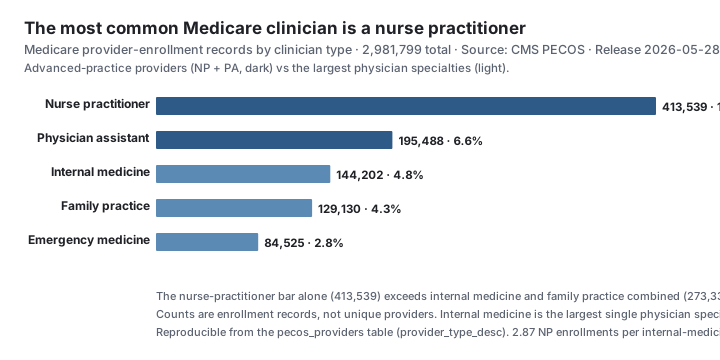
For comparison, the largest single physician specialty — internal medicine — holds 144,202 enrollment records. There are 2.87 nurse-practitioner enrollments for every internal-medicine enrollment. Family practice, the next physician specialty, holds 129,130. The nurse-practitioner line alone (413,539) is larger than internal medicine and family practice added together (273,332).
The single most common clinician enrolled to bill Medicare is no longer a physician of any specialty. It is a nurse practitioner — and by a wide margin.
One in five enrollments is an NP or a PA
Add the physician assistant — 195,488 records (6.6%) — to the nurse practitioner, and the two advanced-practice categories total 609,027 enrollments, 20.4% of the file. One in five Medicare provider-enrollment records belongs to an NP or a PA.
This is the enrollment-side mirror of a shift CMS's own advisors have tracked on the claims side. MedPAC reports that nurse practitioners and physician assistants now deliver roughly a quarter of all Medicare clinician visits, and that the amount these clinicians bill directly — under their own NPI rather than incident-to a physician — rose sharply over the past five years. The enrollment file is where that shift is registered first: a clinician must be enrolled in PECOS under their own provider type before they can bill under it.
Why the advanced-practice share is so large
Three structural forces sit underneath the number.
Scope-of-practice expansion. Over the past two decades, a growing number of states have granted nurse practitioners full or reduced practice authority — the legal ability to evaluate, diagnose, and prescribe without mandatory physician oversight. Each expansion makes independent Medicare enrollment both possible and worthwhile.
Primary-care economics. Advanced-practice providers are the workforce health systems use to extend access as physician primary-care supply flattens. They train faster and are compensated below physician levels, so a system expanding access into underserved areas enrolls NPs and PAs to do it.
The 85% rule. When a service is billed under an NP's or PA's own NPI, Medicare pays 85% of the physician fee schedule rate; the same service billed incident-to a supervising physician pays 100%. That payment differential is precisely why direct, own-NPI enrollment — the thing PECOS records — has become the policy question MedPAC keeps returning to.
An enrollment record is a billing-privilege grant, not a claim. This study counts who is enrolled to bill Medicare under each provider type — not how much each provider actually billed. Enrollment is the leading indicator; utilization is the lagging one.Individuals versus organizations
Most of the file is people. 2,548,303 records (85.5%) carry an individual last name; 433,496 (14.5%) are organizational enrollments carrying an org name instead. The largest organizational provider type is the Part B supplier clinic or group practice — 239,492 records (8.0%), the second-largest category overall behind nurse practitioners. That single fact captures how Medicare is organized today: a vast base of individually-enrolled clinicians, billing through a dense layer of group practices and clinics.
Where providers enroll
Enrollment concentration tracks population and provider supply. California leads with 262,214 records (8.8% of the file), followed by Texas (207,328, 7.0%), New York (198,758, 6.7%), Florida (185,769, 6.2%), and Pennsylvania (127,899, 4.3%). The geography is unremarkable on purpose: enrollment counts scale with the number of providers in a state, so the largest states lead. These are record counts, not per-capita enrollment rates.
What one PECOS record actually is
Each row in the file represents one provider's enrollment to bill Medicare under one provider type. Enrollment is governed by 42 CFR Part 424, Subpart P: a provider or supplier submits a Form CMS-855 application — on paper or through internet-based PECOS — and the Medicare contractor validates eligibility, confirms practice locations and ownership, and grants billing privileges. Because the unit is the enrollment, not the person, a single NPI can appear under more than one provider type or location. That is why the file holds about 1.17 records per distinct NPI, and why every count in this study is reported as enrollment records, not unique individuals.
How this differs from our deactivation study
This study is the composition layer — who is enrolled, and under what provider type. Our companion study, The Medicare deactivation spike: where providers are dropping off, is the churn layer: it tracks providers leaving the enrollment file and where those exits cluster. Read together, they describe both the standing shape of the Medicare provider base and how it turns over. Neither names nor surfaces any individual provider — both are aggregate-only.
Methodology
All counts are direct aggregations over the pecos_providers table, populated from the CMS PECOS Ordering & Referring / provider-enrollment extract (federal release 2026-06-18, 2,981,799 records, public, read-only). Provider-type counts use the CMS-published provider_type_desc field. Individual-versus-organization split uses the presence of an org_name value. State shares use the state_cd field. The exact query is in the reproducibility block below and on the PECOS dataset page; every count resolves to a specific row in a specific frozen federal snapshot. Methodology version: pecos-enrollment/v1.
Limitations
- Snapshot, not a trend. These figures reflect the 2026-06-18 federal release. Enrollment is continuous; counts shift with every monthly refresh.
- Records, not people. Counts are of enrollment records. One NPI can hold several records across provider types or locations, so category totals exceed the number of distinct providers.
- Enrollment, not utilization. A PECOS record is a billing-privilege grant, not a claim. This study measures who is enrolled, not how much each provider billed.
- CMS taxonomy. Provider type is CMS's own enrollment classification (325 categories). It reflects the basis of enrollment, which usually but not always tracks a clinician's day-to-day role.
- Not a quality metric, and aggregate-only. Enrollment counts are a workforce-composition signal, never a measure of care quality. No individual provider is named, surfaced, or attached to any profile in this study.
Sources
- CMS — Provider Enrollment, Chain and Ownership System (PECOS) — the federal enrollment system of record.
- CMS — Ordering & Referring dataset (data.cms.gov) — the public PECOS-derived enrollment extract behind this study.
- 42 U.S.C. — 42 CFR Part 424, Subpart P: Requirements for Establishing and Maintaining Medicare Billing Privileges — the governing enrollment regulation.
- MedPAC — Improving Medicare's payment policies for APRNs and physician assistants — advanced-practice billing growth and the share of Medicare visits.
- CMS — Advanced Practice Non-Physician Practitioners — the 85% physician-fee-schedule payment rule.
Frequently asked questions
- What is PECOS / Medicare provider enrollment?
- PECOS is the Provider Enrollment, Chain and Ownership System — the federal system of record for who is approved to bill Medicare. Enrollment, governed by 42 CFR Part 424 Subpart P, validates a provider's eligibility, confirms practice locations and owners, and grants Medicare billing privileges via a Form CMS-855 application.
- Why are nurse practitioners the most common Medicare clinician?
- Two forces. State scope-of-practice laws have steadily expanded what NPs may do independently, and health systems lean on advanced-practice providers to fill access gaps as primary-care physician supply flattens. MedPAC reports NPs and physician assistants now deliver about a quarter of all Medicare clinician visits.
- Does enrolling in PECOS mean Medicare pays the provider in full?
- Not necessarily. Enrollment grants billing privileges; it does not set the payment rate. When a service is billed under a nurse practitioner's or physician assistant's own NPI, Medicare generally pays 85% of the physician fee schedule rate — versus 100% when the same service is billed incident-to a supervising physician.
- What is the difference between PECOS and NPPES?
- CMS assigns National Provider Identifiers through NPPES to eligible individuals and organizations; HIPAA-covered providers must obtain one for standard transactions. PECOS is the Medicare enrollment layer: an enumerated provider can have an NPI without an active PECOS enrollment. This study counts PECOS enrollment records, not NPPES records.
- Why are there more enrollment records than providers?
- Because enrollment is per provider type and location, not per person. A clinician who enrolls under two provider types, or a supplier enrolling multiple practice locations, generates several PECOS records under one NPI. The file holds 2,981,799 records across 2,556,656 distinct NPIs — about 1.17 records per provider.
- Is a provider type the same as what the clinician actually does?
- Roughly, not exactly. The provider_type_desc field is CMS's own enrollment taxonomy — 325 categories spanning clinicians, suppliers, and organizational entities such as clinics and group practices. It reflects the basis on which a provider enrolled to bill Medicare, which usually but not always tracks their day-to-day clinical role.
- Can I reproduce these numbers?
- Yes. Every figure is a direct count over the 2,981,799-record pecos_providers table from the 2026-06-18 federal release. The exact SQL is published in the reproducibility block below and on the PECOS dataset page. Each count resolves to specific rows in a specific frozen federal snapshot.
Who uses this data
The source data behind this study is public
Compliance teams, journalists, and researchers work from the same federal source families cited above — queried by NPI or facility identifier through Fonteum’s open dataset pages and API. Every figure traces to a frozen, downloadable snapshot you can reproduce yourself.
Datasets used
Reproducibility
Every claim, reproducible
The SQL
-- Medicare provider enrollment (PECOS), explained — fully reproducible query.
--
-- Source:   CMS PECOS Ordering & Referring / provider-enrollment extract.
-- Snapshot: cms-pecos / federal release 2026-06-18, 2,981,799 enrollment records.
-- Table:    public.pecos_providers (public, read-only).
-- Identity: one row = one Medicare provider-enrollment record, keyed by NPI +
--           provider_type_cd. A single NPI can hold multiple enrollment records
--           (different provider types / states), so records > distinct NPIs.
--
-- Every headline figure in the study resolves to one of the rows below.
-- Audit observation: 2026-07-14. Source release is returned by query.
-- audit-claim: pecos-universe
WITH totals AS (
  SELECT
    count(*)                                                         AS enrollment_records,
    count(DISTINCT npi)                                             AS distinct_providers,
    count(*) FILTER (WHERE org_name IS NOT NULL AND org_name <> '') AS org_records,
    count(*) FILTER (WHERE last_name IS NOT NULL AND last_name <> '') AS individual_records,
    count(DISTINCT provider_type_desc)                             AS distinct_provider_types,
    count(DISTINCT state_cd)                                       AS jurisdictions,
    max(source_release_date)                                       AS federal_release
  FROM public.pecos_providers
)
SELECT
  t.enrollment_records,                                                    -- 2,981,799
  t.distinct_providers,                                                    -- 2,556,656
  round(t.enrollment_records::numeric / t.distinct_providers, 3)
                                                  AS records_per_provider, -- 1.166
  t.org_records,                                                           -- 433,496
  t.individual_records,                                                    -- 2,548,303
  round(100.0 * t.org_records / t.enrollment_records, 1)
                                                  AS org_pct,              -- 14.5%
  t.distinct_provider_types,                                               -- 325
  t.jurisdictions,                                                         -- 56
  t.federal_release                                                        -- 2026-06-18
FROM totals t;

-- audit-claim: provider-type-vector
WITH total AS (
  SELECT count(*) AS enrollment_records FROM public.pecos_providers
), selected AS (
  SELECT provider_type_desc, count(*) AS records
  FROM public.pecos_providers
  WHERE provider_type_desc IN (
    'PRACTITIONER - NURSE PRACTITIONER',
    'PART B SUPPLIER - CLINIC/GROUP PRACTICE',
    'PRACTITIONER - PHYSICIAN ASSISTANT',
    'PRACTITIONER - INTERNAL MEDICINE',
    'PRACTITIONER - FAMILY PRACTICE',
    'PRACTITIONER - PHYSICAL THERAPIST IN PRIVATE PRACTICE',
    'PRACTITIONER - EMERGENCY MEDICINE'
  )
  GROUP BY provider_type_desc
)
SELECT
  selected.provider_type_desc AS provider_type,
  selected.records,
  round(100.0 * selected.records / total.enrollment_records, 2) AS pct
FROM selected
CROSS JOIN total
ORDER BY records DESC
;
--  PRACTITIONER - NURSE PRACTITIONER                413,539  13.87   <- single largest type
--  PART B SUPPLIER - CLINIC/GROUP PRACTICE          239,492   8.03   <- largest organizational type
--  PRACTITIONER - PHYSICIAN ASSISTANT               195,488   6.56
--  PRACTITIONER - INTERNAL MEDICINE                 144,202   4.84   <- largest single physician specialty
--  PRACTITIONER - FAMILY PRACTICE                   129,130   4.33
--  PRACTITIONER - PHYSICAL THERAPIST IN PRIVATE...  126,499   4.24
--  PRACTITIONER - EMERGENCY MEDICINE                 84,525   2.83

-- audit-claim: advanced-practice-summary
SELECT
  (SELECT count(*) FROM public.pecos_providers
     WHERE provider_type_desc IN ('PRACTITIONER - NURSE PRACTITIONER',
                                  'PRACTITIONER - PHYSICIAN ASSISTANT'))          AS np_pa_records,   -- 609,027
  round(100.0 * (SELECT count(*) FROM public.pecos_providers
     WHERE provider_type_desc IN ('PRACTITIONER - NURSE PRACTITIONER',
                                  'PRACTITIONER - PHYSICIAN ASSISTANT'))
     / (SELECT count(*) FROM public.pecos_providers), 2)                         AS np_pa_pct,       -- 20.42%
  round(
    (SELECT count(*)::numeric FROM public.pecos_providers
       WHERE provider_type_desc = 'PRACTITIONER - NURSE PRACTITIONER')
    / (SELECT count(*) FROM public.pecos_providers
       WHERE provider_type_desc = 'PRACTITIONER - INTERNAL MEDICINE'), 2)        AS np_to_internal_med_ratio, -- 2.87
  (SELECT count(*) FROM public.pecos_providers
     WHERE provider_type_desc IN ('PRACTITIONER - INTERNAL MEDICINE',
                                  'PRACTITIONER - FAMILY PRACTICE'))             AS internal_plus_family_records; -- 273,332

-- audit-claim: pecos-state-vector
SELECT
  state_cd                                                  AS state,
  count(*)                                                  AS records,
  round(100.0 * count(*) / sum(count(*)) OVER (), 2)        AS pct
FROM public.pecos_providers
GROUP BY state_cd
ORDER BY records DESC
LIMIT 5;
--  CA  262,214  8.79
--  TX  207,328  6.95
--  NY  198,758  6.67
--  FL  185,769  6.23
--  PA  127,899  4.29
The snapshot
| dataset_id | cms-pecos |
| snapshot_date | 2026-06-18 |
The JOINs
enrollment_records  = count(*) from pecos_providers              -- 2,981,799 records
distinct_providers  = count(distinct npi)                        -- 2,556,656 NPIs (records > NPIs: one provider can hold several enrollments)
nurse_practitioners = count(*) where provider_type_desc = 'PRACTITIONER - NURSE PRACTITIONER'  -- 413,539 = 13.87%
np_pa_share         = count(*) where provider_type_desc in (NP, PA) / count(*)  -- 609,027 / 2,981,799 = 20.42%
np_to_internal_med  = np_records / internal_medicine_records      -- 413,539 / 144,202 = 2.87x
The pipeline version
| methodology_version | pecos-enrollment/v1 |
Reproduce this
Run the exact query against the frozen 2026-06-18.
Cite this study
Citation-ready for researchers and AI.
Check the chain
The cited snapshot identifies the federal file. Where an attestation is present, its file hash can be re-derived; figures are not individually signed.
cms-pecos · 2026-06-18Not suppliedInspect supplied artifact- ACCESS · JUN 2026Healthcare Deserts: Where Care Disappears in America (2026)Two-thirds of America's active health-care shortage areas are rural: 13,999 of the 21,133 designated Health Professional Shortage Areas — 66.2% — sit in rural communities, against 6,069 non-rural ones. The rural skew holds across primary care (66.0%), mental health (65.3%), and dental health (67.4%) alike, spanning 25,281 federal designations in 60 jurisdictions.
- ACCESS · APR 2026A March spike in Medicare enrollment deactivations thinned provider supply in shortage areasMedicare enrollment deactivations in PECOS ran 28% above the trailing-twelve-month average in March 2026 — and the spike was not uniform. Deactivations in HRSA-designated shortage areas grew 41% against trend, versus 19% elsewhere. The places least able to absorb a departure lost providers fastest.
- FINANCIAL DISTRESS · JUN 2026The OIG exclusion list, explained: who gets barred from Medicare, and whyThe OIG List of Excluded Individuals and Entities (LEIE) holds 68,055 active exclusions spanning 1977–2026. The most common reason to be barred from Medicare is not fraud — it is losing a state license: §1128(b)(4) license actions are 41% of the list. And only 10.3% of records carry an NPI, so the list is mostly non-clinicians.
- WORKFORCE · JUN 2026Zero-RN days: how often US nursing homes ran a day with no registered nurse on the floorIn the CMS Payroll-Based Journal's 2025 Q2 snapshot, 5.86% of nursing-home facility-days with residents present recorded zero registered-nurse direct-care hours — 77,542 days across 5,062 facilities. The rate ranged from 27.9% in Louisiana to 0.2% in Rhode Island. Days before the federal staffing floor was rescinded, this is the baseline the country now keeps.
- FINANCIAL DISTRESS · JUN 2026Rural hospital closures, by the numbers: which hospitals are most at riskRural Critical Access Hospitals — the small facilities at the center of the closure crisis — run a 50.4% financial-distress rate, against 39.2% for urban hospitals, across 6,019 Medicare hospitals in the federal HCRIS cost reports. Their average operating margin is −8.93%, and 682 are losing money on patient care.
Federal source citations
Fonteum LLC · June 11, 2026 · All figures trace to the frozen federal-data snapshot cited above.