cms-hospital-compare · CMS
cms-hospital-compare · CMS
cms-hospital-compare · CMS
What is the HAC Reduction Program?
The Hospital-Acquired Condition Reduction Program (HACRP) is a Medicare payment-adjustment program that reduces payments to the worst-performing quartile of hospitals by 1 percent. It is distinct from the Deficit Reduction Act HAC payment provision, which affects payment for individual cases — for the definition of hospital-acquired conditions and CMS's 14 HAC categories, see the hospital-acquired conditions explainer.
Statutory authority and effective date
The HAC Reduction Program was established by Section 3008 of the Affordable Care Act and took effect in FY2015 (beginning October 1, 2014). CMS calculates a Total HAC Score for each eligible hospital each year and reduces payments for hospitals above the 75th percentile.
Which hospitals are subject to penalties
The program applies to subsection (d) hospitals paid under the Inpatient Prospective Payment System. Critical access hospitals, rehabilitation, long-term care, psychiatric, children's, and PPS-exempt cancer hospitals are excluded, and Maryland hospitals are specifically exempt from the payment reduction.
How CMS calculates HAC penalties
The Total HAC Score formula
CMS calculates a Total HAC Score for each eligible hospital as the equally weighted average of six measure scores: the CMS PSI 90 composite (10 patient safety indicators from Medicare claims) and five CDC NHSN infection measures — CLABSI, CAUTI, SSI, MRSA bacteremia, and CDI. Each measure is converted to a winsorized z-score before averaging, so a higher Total HAC Score is worse.
The 75th-percentile threshold
Hospitals with a Total HAC Score above the 75th percentile of all eligible hospitals take the 1-percent payment reduction. The threshold is a relative national ranking rather than a fixed clinical target, so approximately the worst-performing quartile is penalized each active year by construction.
The 1-percent payment reduction mechanism
The penalty is a 1-percent reduction applied to all Medicare fee-for-service payments for the fiscal year — not only to discharges involving a hospital-acquired condition. The reduction has remained at 1 percent since the program began. Hospitals receive a confidential Hospital-Specific Report and a 30-day Scoring Calculations Review and Correction period before the determination becomes final.
FY2026 penalty status, rolled up by state
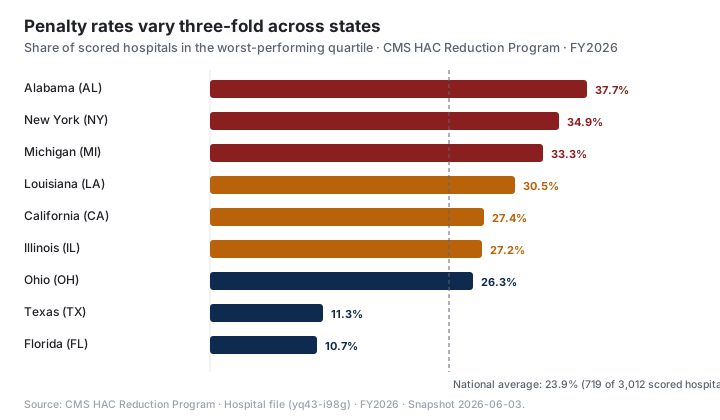
Fonteum reads the CMS HAC Reduction Program Hospital file at the facility level — one row per hospital, keyed on the 6-character CCN. For FY2026 that is eligible hospitals, of which (23.9% of the 3,012 scored) sit above the 75th-percentile Total HAC Score and take the 1-percent reduction. The table below rolls those facility rows up to the state level for the 20 states with the most eligible hospitals. Penalty rate is the penalized count divided by scored hospitals; the 43 hospitals recorded N/A nationally are excluded from every rate denominator.
| State | Scored hospitals | Penalized | Penalty rate |
|---|---|---|---|
| Texas (TX) | 284 | 32 | 11.3% |
| California (CA) | 277 | 76 | 27.4% |
| Florida (FL) | 169 | 18 | 10.7% |
| Pennsylvania (PA) | 133 | 36 | 27.1% |
| New York (NY) | 129 | 45 | 34.9% |
| Ohio (OH) | 118 | 31 | 26.3% |
| Illinois (IL) | 114 | 31 | 27.2% |
| Georgia (GA) | 94 | 27 | 28.7% |
| Michigan (MI) | 90 | 30 | 33.3% |
| Louisiana (LA) | 82 | 25 | 30.5% |
| Indiana (IN) | 82 | 10 | 12.2% |
| North Carolina (NC) | 80 | 20 | 25% |
| Tennessee (TN) | 78 | 15 | 19.2% |
| Alabama (AL) | 77 | 29 | 37.7% |
| Oklahoma (OK) | 76 | 15 | 19.7% |
| Virginia (VA) | 71 | 5 | 7% |
| Wisconsin (WI) | 65 | 16 | 24.6% |
| Arizona (AZ) | 64 | 12 | 18.8% |
| Missouri (MO) | 63 | 9 | 14.3% |
| New Jersey (NJ) | 61 | 5 | 8.2% |
Data last updated: 2026-06-03 · FY2026 (Oct 1, 2025 – Sep 30, 2026) · CMS snapshot read directly from the CMS Provider Data Catalog.
Understanding the Total HAC Score and domain scores
Each hospital's Total HAC Score is the equally weighted average of its Domain 1 score (CMS PSI 90 composite, derived from Medicare claims) and its Domain 2 score (the average of five CDC NHSN healthcare-associated infection measure scores). Across FY2026 the national median Total HAC Score is -0.045 and the 75th-percentile cut sits near 0.379 — hospitals above that line are the penalized quartile. This dataset covers the HAC Reduction Program, a payment-adjustment program, and not the DRA HAC payment provision, which affects individual case payments. These are two distinct CMS programs.
The HAC Reduction Program since FY2015
CMS applies the 1-percent payment reduction to all Medicare fee-for-service discharges for the fiscal year — from October 1 through September 30 — for hospitals with a Total HAC Score above the 75th percentile. The penalty has remained at 1 percent of all Medicare fee-for-service payments since the program's inception in FY2015 under the Affordable Care Act Section 3008. Because the threshold is a relative national ranking, roughly the worst-performing quartile is penalized each active year by construction.
The FY2023 program pause
CMS paused use of all HAC Reduction Program measures in the FY2023program year because of COVID-19 data disruption. The pause means a clean multi-year facility comparison has a gap at FY2023; Fonteum's facility data on this page is FY2026, the current published program year, and does not interpolate the paused year.
Measurement periods for FY2026
For FY2026, the CMS PSI 90 performance period covers discharges from July 1, 2022 through June 30, 2024; the five CDC NHSN healthcare-associated infection measures cover January 1, 2023 through December 31, 2024. Both windows are stored per measure family so the limitation surface can show the correct period for each score.
For the policy background — what hospital-acquired conditions are and CMS's 14 HAC categories — see the hospital-acquired conditions explainer.
Source comparison: grain, cadence, and access
No public competitor — including CMS itself — combines facility scores, penalty status, and state rollups in this page's structure. The page names the CMS source and fiscal period; a separately stored snapshot attestation covers only its identified snapshot object and does not sign the displayed values. CMS publishes the raw file; the hospital associations publish advocacy analyses.
| Source | Data grain | Cadence | Access | Provenance |
|---|---|---|---|---|
| Fonteum | Facility (CCN) + state rollups | Annual (FY) | Free, web + provenance chain | 14-tuple chain |
| CMS data.cms.gov | Facility (CCN), raw file | Annual (FY) | Free flat file, no analysis layer | Source file only |
| American Hospital Association | Advocacy / program critique | Editorial | Free pages + member tools | None |
| State hospital associations | Single-state PDF analyses | Occasional | Free PDFs | None |
Methodology
Data sources and processing steps
The penalty figures are read from the CMS HAC Reduction Program Hospital file in the CMS Provider Data Catalog — never from an aggregator. The pipeline resolves the current CMS download URL from the provider-data metastore (the resource hash rotates on each CMS publish), then runs entity resolution on the CCN, extracts the Total HAC Score, the six component measures, and the payment-reduction determination, validates the counts against the published CMS totals, and records available snapshot metadata. Displayed values identify the CMS source and fiscal period; attestation coverage is snapshot-specific, not a signature on each value. A suppressed measure (blank value plus a footnote code) is treated as suppressed, not as zero, and an N/A payment-reduction status is stored as null, never as a pass.
Update cadence
The CMS Hospital file refreshes annually by federal fiscal year. Fonteum re-reads it on each publish and records the new snapshot date; the full 14-tuple contract is on the data sources reference and the methodology library.
Sources
- HAC Reduction Program — Hospital file — Centers for Medicare & Medicaid Services (CMS) · data.cms.gov, Annual (by federal fiscal year). Primary source ↗ · Archive ↗
Used for: FY2026 facility-level Total HAC Score, the six component measures, and the worst-quartile payment-reduction determination for 3,055 hospitals. - Hospital Acquired Conditions (Value-Based Programs / HACRP) — Centers for Medicare & Medicaid Services (CMS), Annual program year. Primary source ↗ · Archive ↗
Used for: Program structure, the six quality measures, the 75th-percentile threshold, exemptions, and the 1-percent payment reduction. - Hospital-Acquired Condition Reduction Program (IPPS / PPS) — Centers for Medicare & Medicaid Services (CMS), Annual rulemaking. Primary source ↗ · Archive ↗
Used for: Scoring review and correction process, Hospital-Specific Report timing, and the data publication path. - National Scorecard on Hospital-Acquired Conditions — Agency for Healthcare Research and Quality (AHRQ), Periodic scorecard. Primary source ↗ · Archive ↗
Used for: Context on national HAC trends, including the 13% decline from 2014 to 2017.
Data last updated: 2026-06-03 · Reviewed by Jennifer Montecillo, MD · June 2026. Non-practicing medical reviewer.
Frequently asked questions about HAC penalties
- How much is the HAC reduction program penalty?
- The HAC Reduction Program penalty is a 1-percent reduction in all Medicare fee-for-service payments for a fiscal year. The reduction applies to every Medicare discharge during the fiscal year — October 1 through September 30 — for hospitals whose Total HAC Score falls above the 75th percentile of all eligible hospitals. The penalty has remained at 1 percent since the program began in FY2015.
- Which hospitals received HAC penalties in FY2026?
- For FY2026, 719 of the 3,012 scored hospitals (23.9%) fall in the worst-performing quartile and take the 1-percent payment reduction, out of 3,055 eligible hospitals; 43 had insufficient data to be scored. The state-by-state breakdown on this page shows how penalty rates range from about 7% to nearly 38% across the states with the most eligible hospitals, all sourced from the CMS Hospital file.
- How does CMS determine which hospitals are penalized?
- CMS calculates a Total HAC Score for each eligible hospital as the equally weighted average of six measure scores: the CMS PSI 90 composite (10 patient safety indicators from Medicare claims) and five CDC NHSN infection measures (CLABSI, CAUTI, SSI, MRSA, CDI). Hospitals with a Total HAC Score above the 75th percentile of all eligible hospitals take the 1-percent payment reduction.
- When does CMS publish HAC penalty results?
- CMS publishes hospital-level HAC Reduction Program data on data.cms.gov for each program year, typically in the first quarter of the calendar year. Hospitals receive confidential Hospital-Specific Reports first; the public data file is updated after the 30-day Scoring Calculations Review and Correction period closes. Fonteum re-reads the published file on each refresh and records the snapshot date in the provenance chain.
- Can a hospital appeal an HAC penalty?
- CMS provides a 30-day Scoring Calculations Review and Correction period during which hospitals can review their Hospital-Specific Report, ask questions about how their score was calculated, and request corrections to data errors. This is a correction window for calculation errors, not a traditional appeal. Once the correction period closes, penalty determinations are final for that fiscal year.
- What is the difference between Domain 1 and Domain 2 HAC scores?
- Domain 1 is the CMS PSI 90 composite — a claims-based measure derived from Medicare fee-for-service billing data. Domain 2 is the set of five healthcare-associated infection measures (CLABSI, CAUTI, SSI, MRSA, CDI) that hospitals report to the CDC National Healthcare Safety Network. The Total HAC Score is the equally weighted average of the available component measure scores across both domains.
- How long has the HAC Reduction Program been in effect?
- The HAC Reduction Program took effect in FY2015 (beginning October 1, 2014), established by Section 3008 of the Affordable Care Act. CMS paused all HAC Reduction Program measures in the FY2023 program year because of COVID-19 data disruption. The program reduces the worst-performing quartile of eligible hospitals' Medicare payments by 1 percent each active fiscal year.
For background on what hospital-acquired conditions are and how CMS classifies them, see the hospital-acquired conditions explainer, browse the Learn hub, read more Fonteum research studies, or explore nursing-home deficiency correction times and our data sources.
Reviewed by Jennifer Montecillo, MD, medical reviewer. Non-practicing medical reviewer. · Last updated: June 2026. Statutory authority: Section 3008 of the Affordable Care Act (Pub. L. 111-148). See hhs.gov for the regulatory framework.
Re-derive this
Every figure on this page comes from the named federal file below, as of 2026-06-03. The downloads carry the same figures in machine-readable form, so a reader can re-check the numbers against the source instead of taking them on trust.
- HAC Reduction Program — Hospital file — U.S. Centers for Medicare & Medicaid Services, retrieved 2026-06-03.
Download the data: Download JSON · Download CSV · Download re-derivation SQL
Methodology cms-hac-reduction-program/v1 · data as of 2026-06-03 · CSV 3875 bytes · SHA-256 ddb56cdcbabba465… · the SQL download is the query these figures come from.