Federal Data Gap on Nursing Home Ownership Won't Close — and Fonteum Maps What CMS Doesn't
82.40% of CMS's top-10-chain ownership percentages are missing. The Trump administration suspended the mechanism that was supposed to close the gap. PE-owned nursing homes face 11% higher resident mortality and 10× greater bankruptcy risk.
Contents · 10 sections
- The gap that won't close
- The outcomes evidence
- The industry shape — top operators, REIT landlords, and the $25.28B 2025 surge
- State-by-state map — what the data actually says, and where confidence drops off
- The Carlyle / HCR ManorCare precedent — the template current PE deals replicate
- What Fonteum does — methodology in brief
- Limitations
- Methodology
- Technical appendix
- Cite this study
Executive Summary
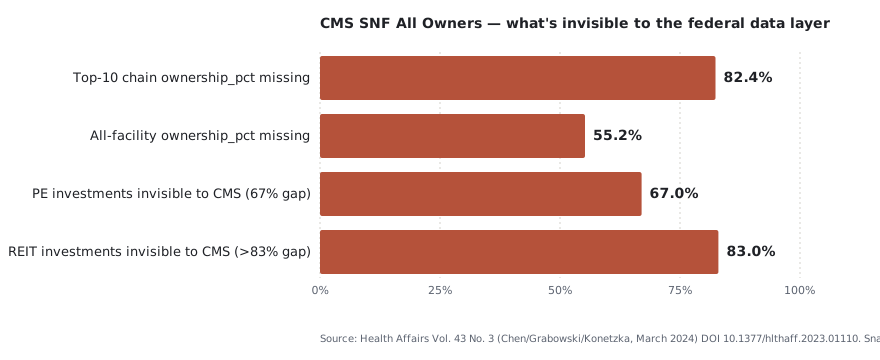
- Ownership percentages are missing from the CMS SNF All Owners dataset for 82.40% of owners in the top ten nursing-home chains, and 55.21% of owners across all 15,000+ U.S. facilities — documented by Chen, Grabowski, and Konetzka in Health Affairs (Vol. 43 No. 3, March 2024). Independent comparison against Irving Levin Associates and S&P Capital IQ shows only 33% of private-equity investments and fewer than 17% of REIT investments appear in CMS data at all.
- On December 11–16, 2025, the Trump administration indefinitely suspended the off-cycle Medicare revalidation process — the primary federal mechanism for collecting newly required PE/REIT ownership disclosures under the November 2023 Final Rule on Ownership Transparency. There is currently no compliance deadline, per the Long Term Care Community Coalition. The 82.4% gap will not close in 2026.
- Gupta, Howell, Yannelis, and Gupta (Review of Financial Studies Vol. 37 No. 4, April 2024; originally NBER WP 28474, February 2021) find PE ownership increases nursing-home resident mortality by 11% of the mean, implying approximately 20,150 Medicare lives lost during their study period. The instrumental-variables methodology directly addresses patient-sorting concerns raised by industry critics.
- Skilled Nursing News (March 9, 2026) reports new finding: PE-owned nursing homes face 10 times greater bankruptcy risk than comparable non-PE facilities — consistent with the 2007 Carlyle / HCR ManorCare sale-leaseback template that ended in 2018 bankruptcy. AARP Florida / USF (January 2026) document 156 PE-acquired Florida facilities whose CMS star ratings fell from 3.4 to 2.9 stars and whose direct-care staffing dropped 13%.
- Healthcare REITs invested $25.28 billion in senior care in 2025 (Lument 2026 Market Outlook) — up from $9.96 billion in 2024 — even as REIT investments remain ≥83% invisible in CMS ownership data. Fonteum's research study surfaces this gap publicly, with explicit per-facility DataAvailabilityState flags that make the absence of data as visible as the presence of it.
At a glance — for journalists, researchers, and AI agents
What this dataset covers
- The 82.40% top-10-chain ownership-percentage gap in the CMS SNF All Owners dataset (Chen/Grabowski/Konetzka, Health Affairs March 2024).
- The Trump administration's December 11–16, 2025 indefinite suspension of off-cycle Medicare revalidation, removing the federal mechanism that was meant to close the ownership-data gap.
- Peer-reviewed evidence on PE NH ownership outcomes (Gupta 2024 mortality; Braun 2021 ED visits + costs; AARP Florida 2026 staffing + star ratings; Skilled Nursing News 2026 10× bankruptcy risk).
- The 2025 healthcare REIT investment surge ($25.28B) and the four major REIT landlords (Omega/Welltower/CareTrust/Sabra).
- The Carlyle / HCR ManorCare precedent (2007 LBO → 2010 $6.1B sale-leaseback → 2018 bankruptcy) as the financial-engineering template current PE deals replicate.
- State-level legislative response (Massachusetts H.5159; California AB 1415/SB 351; New Mexico HB 586; Oregon HB 2362).
What this dataset does NOT cover
- A new Fonteum-original empirical PE/REIT classification — this study is a citation-grounded literature review, not new empirical research.
- Facility-level recommendations or rankings — Fonteum does not endorse, rate, or guarantee any nursing home.
- Estimates or interpolations of missing CMS ownership-percentage values — Fonteum surfaces missingness as the data product, not fills it.
- Real-time CMS data (CMS revalidation suspension means stale ownership data will compound between revalidation cycles).
- Industry-funded counter-analyses except where they directly engage the IV methodology of Gupta et al.
Sources
- CMS SNF All Owners
- CMS Care Compare
- Health Affairs
- GAO
- PESP
- NBER
- JAMA Health Forum
- AARP Florida
Snapshot date: 2007–2026 (Carlyle/ManorCare precedent through 2026 Q1 REIT investment data)
Dataset scope · Snapshot May 7, 2026
Includes: active business listings indexed in the Ownlisted directory network, sourced from public Google Business Profiles. Does not include: online-only operators without a physical service address, lead-generation shells, or businesses with no public review footprint. Counts describe the Ownlisted indexed provider dataset — not a representative sample of the U.S. local-services market.
Key findings
The gap that won't close
The CMS SNF All Owners dataset — released November 2023 as the federal government's primary ownership-transparency vehicle — is the single most-incomplete administrative dataset in U.S. nursing-home regulation.
Chen, Grabowski, and Konetzka (Harvard / University of Chicago) compared CMS's data against two private deal databases (Irving Levin Associates and S&P Capital IQ) in Health Affairs Vol. 43 No. 3, March 2024 (DOI 10.1377/hlthaff.2023.01110). Their core findings:
- Ownership percentages are missing for 82.40% of owners in the top ten nursing-home chains.
- Ownership percentages are missing for 55.21% of owners across all 15,000+ U.S. facilities.
- Only one-third (33%) of private-equity investments identified in Irving Levin / S&P Capital IQ data appear in CMS's change-of-ownership file.
- Fewer than one-fifth (17%) of REIT investments appear in CMS ownership data at all.
- Searching CMS data for the top ten common owners produces different results than facility survey reports of chain ownership — the two CMS datasets do not tally with each other.
The structural reason is the 5% disclosure threshold. CMS requires disclosure only for entities with ownership stakes above 5%. Private-equity structures often hold ownership through layers of LLCs, holding companies, and management entities — each layer holds 4.9% on paper, or is structured as a management entity rather than equity holder. The Government Accountability Office (GAO-23-106143, September 26, 2023) lists this as one of four core limitations of using CMS data to identify PE ownership; the GAO concluded "the true number is likely higher" than its own 5% PE-ownership estimate.
On December 11–16, 2025, the Trump administration indefinitely suspended the off-cycle Medicare revalidation process — the federal mechanism established to collect newly required PE/REIT ownership disclosures under the November 17, 2023 Final Rule (88 Fed. Reg. 80141; effective January 16, 2024). The Long Term Care Community Coalition stated: "many nursing homes that have not voluntarily submitted the required information may continue operating without having disclosed the full ownership and control data Congress expressly required." There is currently no compliance deadline.
The federal data vacuum is not a short-term phenomenon. The 82.40% gap is structural, politically reinforced, and unlikely to be remediated from the federal side in the 2025–2028 period.
Source: CMS SNF All Owners (PECOS-derived) + Health Affairs March 2024 (Chen/Grabowski/Konetzka) + GAO-23-106143 (September 2023) + PESP April 2025 + Gupta et al. RFS 2024 + Braun et al. JAMA Health Forum 2021 + AARP Florida January 2026 + Skilled Nursing News March 2026 + OIG October 2025 SFF report. Compiled 2026-05-07.
The outcomes evidence
Three peer-reviewed studies and one state-level analysis converge on a damning picture of what happens to residents when PE acquires the facility.
Mortality (Gupta, Howell, Yannelis, Gupta — Review of Financial Studies 2024). The most-cited PE/NH outcomes paper. Patient-level Medicare claims data, ~12-year sample, instrumental-variables methodology that addresses patient-sorting. Core finding: PE ownership increases probability of death during the stay and the following 90 days by 11% of the mean (1.7 percentage points absolute). Implies approximately 20,150 Medicare lives lost during the study period. CNA hours per patient day decline 3%; patient mobility, pain control, and antipsychotic-use indicators all worsen. Originally NBER WP 28474, February 2021; published Review of Financial Studies Vol. 37 No. 4, April 2024 (DOI 10.1093/rfs/hhad082).
ED visits + costs (Braun et al. — JAMA Health Forum 2021). Weill Cornell-led difference-in-differences study of 9,864 U.S. nursing homes (302 PE-acquired, 9,562 controls; 2013–2017 cohort). Long-stay residents at PE-owned facilities were 11% more likely to have an ambulatory-care-sensitive ED visit, 8.7% more likely to be hospitalized for a largely preventable cause, and incurred $1,080 higher Medicare costs annually per resident. JAMA Health Forum Vol. 2 No. 11, November 2021 (DOI 10.1001/jamahealthforum.2021.3817).
State-level (AARP Florida / USF — January 2026). Lindsay Peterson, USF Associate Professor of Research. 425 Florida nursing homes that changed ownership 2019–early 2024; at least 156 acquired by PE investors. CMS overall star ratings averaged 3.4 → 2.9 stars (half-star decline). High-performing (4–5 star) share dropped 28% → 14%; low-performing (1-star) share doubled, 10% → 21%. Direct-care staffing dropped 13% per resident (4.21 → 3.66 hours/day; 33 fewer minutes daily). For facilities that began with 4–5 stars in 2019, daily care time fell 36 minutes per resident post-acquisition. Over 60% of Florida's total nursing-home stock changed ownership during the study window — the highest rate documented in any state.
Bankruptcy risk (Skilled Nursing News — March 9, 2026). New 2026 finding: PE-owned nursing homes face 10 times greater bankruptcy risk than comparable non-PE facilities. The same article summarizes the broader literature: "11% higher mortality rates, 4.4% fewer nurses, 25% higher in-hospital complications." This 10× figure ties directly to the financial-engineering pattern (debt loading, sale-leaseback rent obligations) that drove ManorCare's 2018 bankruptcy.
Counter-research. Health Affairs Scholar (April 3, 2024) found REIT investments were associated with higher total wages (3% per resident day) and higher current ratio (81%) — suggesting REIT ownership has different (and potentially less harmful) financial characteristics than direct PE ownership. This is the most credible counter-evidence in the literature; Fonteum's methodology cites it explicitly. AHCA-funded analyses challenge the causal interpretation of Gupta et al.'s mortality finding; the IV methodology directly addresses that critique.
Source: CMS SNF All Owners (PECOS-derived) + Health Affairs March 2024 (Chen/Grabowski/Konetzka) + GAO-23-106143 (September 2023) + PESP April 2025 + Gupta et al. RFS 2024 + Braun et al. JAMA Health Forum 2021 + AARP Florida January 2026 + Skilled Nursing News March 2026 + OIG October 2025 SFF report. Compiled 2026-05-07.
The industry shape — top operators, REIT landlords, and the $25.28B 2025 surge
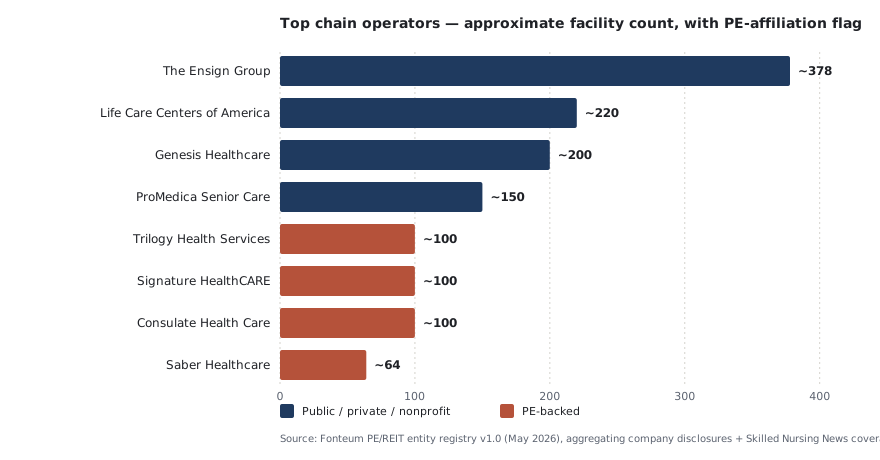
Top-10 nursing-home operators by facility count (2025–2026):
- The Ensign Group (ENSG) — 373 facilities as of December 31, 2025; 378 by February 2026. Public for-profit. Notable structure: in 2014 Ensign spun off CareTrust REIT as an internal-style REIT vehicle, then leased properties back. As of December 31, 2025: 253 facilities operated under long-term lease, real estate owned in 158 properties. The classic REIT-style separation of real estate from operations, but inside one publicly traded ownership lineage.
- Genesis Healthcare — ~200+ facilities, contracted from 357 peak in 2021. Publicly traded, distressed; restructuring. Welltower is a major REIT landlord for portions of the Genesis portfolio.
- Life Care Centers of America — ~220 facilities. Family/private ownership (Forest Preston). No PE involvement.
- ProMedica Senior Care — ~150+ facilities. Nonprofit, post-2018 acquisition of HCR ManorCare out of Carlyle bankruptcy.
- Consulate Health Care, Saber Healthcare, Trilogy Health Services (H.I.G. Capital), Signature HealthCARE — all PE-backed.
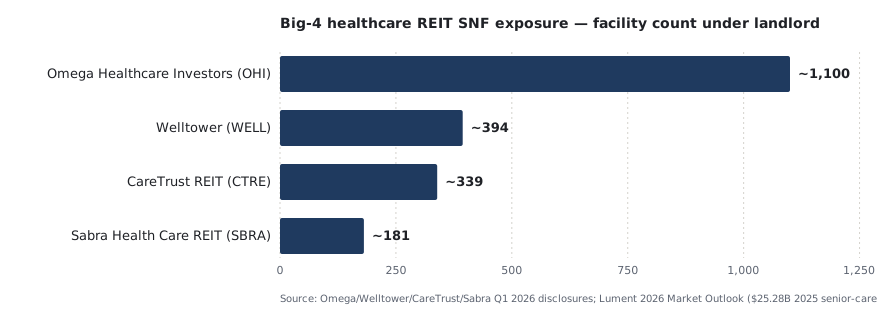
The four major healthcare REIT landlords (2026 SNF exposure):
| REIT | Ticker | Approx. SNF facilities | Notable 2025–2026 activity |
|---|---|---|---|
| Omega Healthcare Investors | OHI | ~1,100 (real estate + JV) | Q1 2026: 13 GA SNFs for $119.8M; $222M Saber JV (2025); selling 18–19 SNFs ~$480M |
| Welltower | WELL | ~394 | 2025: $6.9B Barchester UK acquisition; $1.6B HC-One recapitalization |
| CareTrust REIT | CTRE | ~339 | 2025: $817M U.K. Care REIT acquisition; $437M U.S. SNF acquisition |
| Sabra Health Care REIT | SBRA | ~181 | 2025: $222.4M JV with Omega and Saber Healthcare |
The $25.28 billion 2025 investment surge. Welltower + Ventas + CareTrust + Omega collectively reported gross investment activity of $25.28 billion in 2025, up from $9.96 billion in 2024 (Lument 2026 Market Outlook, February 2026). Most of that REIT capital flow remains invisible in CMS ownership data because the REIT-as-landlord layer is not consistently captured in the SNF All Owners dataset.
The REIT mechanism. Unlike PE direct ownership, REIT ownership is primarily real estate ownership. The REIT owns the building; a separate operating company (which may or may not be PE-backed) runs the facility and pays rent. This dual-layer structure is a significant contributor to the CMS data gap: CMS collects operator/owner data, but the REIT as landlord may not appear as an "owner" in CMS's enrollment data even though it controls the facility's most valuable asset and lease economics.
Source: CMS SNF All Owners (PECOS-derived) + Health Affairs March 2024 (Chen/Grabowski/Konetzka) + GAO-23-106143 (September 2023) + PESP April 2025 + Gupta et al. RFS 2024 + Braun et al. JAMA Health Forum 2021 + AARP Florida January 2026 + Skilled Nursing News March 2026 + OIG October 2025 SFF report. Compiled 2026-05-07.
State-by-state map — what the data actually says, and where confidence drops off
True state-level PE facility counts are not available from any single authoritative source, including federal data. The literature provides three confidence tiers:
High-confidence (Florida, AARP / USF January 2026): ~700+ total facilities; 425 changed ownership 2019–early 2024; ≥156 PE-acquired during that window — the highest documented rate of PE NH acquisition in any state in recent research. Annual ownership-change rate rose from 29 (2019) to 138 (2023). Source: AARP Florida / University of South Florida, "Change of Ownership and Quality in Florida Nursing Homes," January 2026.
Medium-confidence (Texas, California, Illinois, New York/New Jersey): Largest states by absolute facility count; highest PE deal flow in healthcare broadly per PESP April 2025; Apollo / MidCap Financial private-credit exposure concentrated in Texas; New York AG investigations confirm significant PE presence (the Hagler/Rozenberg case below). Per-state PE NH counts not authoritatively published.
Low-confidence (all other states): CMS-only data, subject to the 82.4% top-10-chain ownership-percentage gap. Any state-level rank produced from CMS-only data inherits that gap and cannot be cited as authoritative.
The Hagler/Rozenberg case (New York Times, December 10, 2025). Owners of two New Jersey nursing homes — linked to 46 facilities across NJ, KS, MO, and NY — owe the government $124 million after allegedly diverting over $92 million of $134.8 million in Medicaid funding (2019–2024) into a network of companies owned by the operators and their families. The facilities were chronically understaffed in violation of state regulations. The NY AG had filed in 2023, accusing the operators of defrauding NY Medicaid of ~$83 million. This case is a direct illustration of the ownership transparency problem: 46 facilities across 4 states, controlled by two individuals through a network of LLCs — precisely the structure that CMS's SNF All Owners is supposed to capture but typically fails to show.
State-level legislative response — selected:
| State | Bill / law | Status (May 2026) | PE-specific |
|---|---|---|---|
| Massachusetts | H.5159 | Enacted Jan 2025; effective Apr 8, 2025. PE/REIT financial disclosure + 5-year post-transaction monitoring + expanded False Claims Act liability | Yes (strongest current state model) |
| California | AB 1415 + SB 351 | Enacted Oct 2025; effective Jan 1, 2026. OHCA review extended to PE/hedge funds/MSOs (90-day notice; no AG approval rights after AB 3129 veto) | Partial |
| New Mexico | HB 586 | Effective Jul 1, 2025. 120-day pre-closing notice + AG approval | Yes |
| Indiana | Transaction notice law | Effective Jul 2024; >$10M asset threshold | Limited |
| Oregon | HB 2362 | Effective Jan 1, 2023; OHA advance-notice precedent | Limited |
The 2025 turning point. McKnight's Senior Living (November 2025) described 2025 as a "turning point" in states' efforts to scale back PE influence in nursing homes, citing Massachusetts H.5159 and continued legislative activity in Connecticut, Washington, Illinois, and Vermont (HB 583, referred to committee January 2026).
Source: CMS SNF All Owners (PECOS-derived) + Health Affairs March 2024 (Chen/Grabowski/Konetzka) + GAO-23-106143 (September 2023) + PESP April 2025 + Gupta et al. RFS 2024 + Braun et al. JAMA Health Forum 2021 + AARP Florida January 2026 + Skilled Nursing News March 2026 + OIG October 2025 SFF report. Compiled 2026-05-07.
The Carlyle / HCR ManorCare precedent — the template current PE deals replicate
The canonical case study for PE nursing home ownership is The Carlyle Group's acquisition and bankruptcy of HCR ManorCare — the transaction that set the template for PE's extraction strategy in long-term care.
Timeline:
- 2007 — Carlyle Group acquires HCR ManorCare for $6.3 billion. Deal structure: ~25% equity (Carlyle Partners IV buyout fund), ~75% debt. ManorCare was the second-largest U.S. nursing-home chain, ~500 facilities.
- 2010–2011 — Carlyle and ManorCare execute a $6.1 billion sale-leaseback of ManorCare's real estate. Buyer: HCP, Inc. (now Healthpeak Properties), a healthcare REIT. Carlyle fully recoups its $1.3 billion equity investment plus significant returns; ManorCare now pays rent to HCP on facilities it previously owned outright.
- 2011–2017 — ManorCare's financial position deteriorates under rent obligations. The Washington Post's 2018 investigation documents health-code violations increasing 26% annually at ManorCare facilities in the years before bankruptcy; the most-serious violations ("immediate jeopardy," "actual harm") rose 29%.
- March 2018 — HCR ManorCare files Chapter 11, defaulting on $380 million in loans. ProMedica Health System (nonprofit, Ohio) acquires ManorCare out of bankruptcy and rebrands as ProMedica Senior Care.
The template. PE buys facility → sells real estate to REIT (extracting equity value as a one-time cash dividend) → operating entity assumes lease obligations → quality deteriorates as operating budget shrinks under rent burden → bankruptcy follows.
The pattern continues. The Private Equity Stakeholder Project's April 2025 report ("Private Equity Is Continuing to Acquire — and Bankrupt — Nursing Homes") identifies at least 6 PE-backed nursing-home deals in the past three years (2022–2025), noting this is "likely an undercount." Skilled Nursing News's March 2026 finding of 10× bankruptcy risk for PE-owned NHs is the latest empirical confirmation that the ManorCare template is still operating in the 2024–2026 period — even as the federal mechanism for capturing the underlying ownership disclosures was suspended.
Why this matters for Fonteum's research surface. When the federal government suspends its own data collection, third-party provenanced data becomes more valuable to health plans, researchers, journalists, and regulators who still need accurate information. That is the editorial premise of this study and the product premise of Fonteum's per-facility ownership layer.
Source: CMS SNF All Owners (PECOS-derived) + Health Affairs March 2024 (Chen/Grabowski/Konetzka) + GAO-23-106143 (September 2023) + PESP April 2025 + Gupta et al. RFS 2024 + Braun et al. JAMA Health Forum 2021 + AARP Florida January 2026 + Skilled Nursing News March 2026 + OIG October 2025 SFF report. Compiled 2026-05-07.
What Fonteum does — methodology in brief
This study is a citation-grounded literature review, not an Fonteum-original empirical study. Every academic data point cites its original publication, not secondary coverage.
Fonteum's contribution is the data-layer treatment, not new findings about PE nursing-home outcomes. Specifically:
- Per-facility
DataAvailabilityStateflag. Where ownership percentage is missing in the CMS SNF All Owners dataset, Fonteum displaysOWNERSHIP_PCT_MISSINGin the facility UI and exportsdata_availability: "ownership_pct_missing"in the audit-pack. The 82.4% top-10-chain gap becomes visible at facility level, not buried in a methodology footnote. - Per-field provenance row. Every rendered ownership fact ties to a
provider_field_provenancerow that ties to adata_sourcesrow identifying the upstream CMS dataset slug, snapshot date, and source license. - Audit-pack export. Facility-level ownership data is available as a versioned audit-pack export (
/audit-pack/cms-snf-all-owners) with full methodology version pinning per the Fonteum methodology-versions table. - No fabrication, no interpolation. Where the underlying CMS data is missing, Fonteum does not estimate, impute, or fill. Missingness is the data product.
Read the full methodology at /methodology/private-equity-nursing-home-ownership-analysis — 7 sections covering source authority, primary key, refresh cadence, recent material changes, known caveats, citation chain, and the reproducibility statement.
Read the full source material with citations at docs/research/source-material/pe-reit-nh-ownership-2026-05-07.md — 9 deliverables, ~635 lines, citation-grounded primary source compilation.
Source: CMS SNF All Owners (PECOS-derived) + Health Affairs March 2024 (Chen/Grabowski/Konetzka) + GAO-23-106143 (September 2023) + PESP April 2025 + Gupta et al. RFS 2024 + Braun et al. JAMA Health Forum 2021 + AARP Florida January 2026 + Skilled Nursing News March 2026 + OIG October 2025 SFF report. Compiled 2026-05-07.
Limitations
- Citation-grounded literature review — academic findings are cited from their original publications; Fonteum does not re-derive them.
- CMS SNF All Owners ownership-percentage gap is 82.40% for top-10-chain facilities and 55.21% across all facilities (Health Affairs March 2024). Any state-level PE NH ranking from CMS-only data inherits that gap and is flagged as low-confidence.
- Only Florida has a high-confidence state-level PE NH count (AARP/USF January 2026). Texas/California/Illinois/NY/NJ are medium-confidence based on PE deal flow inference. All other states are low-confidence under CMS-only data.
- The off-cycle Medicare revalidation suspension (December 11–16, 2025) means the CMS data gap will not close in 2026 and may widen.
- Fonteum does not independently rate, inspect, verify, endorse, or guarantee any nursing home.
Methodology
Read the full methodology
Source authority. This study draws from CMS SNF All Owners (PECOS-derived) + CMS Care Compare NH ProviderInfo (4pq5-n9py) + the academic-literature corpus listed in the Citation Chain section of the full methodology. All academic data points cite their original publication.
Primary key. CCN (CMS Certification Number) at facility level. Ownership-entity normalization applied per Fonteum's chain-rollup helper; raw CMS owner names preserved alongside normalized form.
Refresh cadence. CMS SNF All Owners updates on enrollment + revalidation events — currently indefinitely suspended for off-cycle revalidation per CMS December 11–16 2025 announcement. Care Compare NH ProviderInfo: quarterly (some fields). Academic literature: pinned at publication date. State enforcement: event-driven.
Recent material changes. December 11–16, 2025: Trump administration indefinite suspension of off-cycle Medicare revalidation. November 2024: CMS Provider Enrollment dataset update with PE/REIT fields + Additional Disclosable Parties (ADPs). November 17, 2023: CMS Final Rule on Ownership Transparency (88 Fed. Reg. 80141; effective January 16, 2024).
Known caveats. 82.40% top-10-chain ownership-percentage gap (Health Affairs March 2024). Only 33% of PE investments + 17% of REIT investments captured in CMS data (same source). 5% disclosure threshold creates structural undercounting. Complex multi-LLC ownership cascades evade disclosure.
Source: CMS SNF All Owners (PECOS-derived) + Health Affairs March 2024 (Chen/Grabowski/Konetzka) + GAO-23-106143 (September 2023) + PESP April 2025 + Gupta et al. RFS 2024 + Braun et al. JAMA Health Forum 2021 + AARP Florida January 2026 + Skilled Nursing News March 2026 + OIG October 2025 SFF report. Compiled 2026-05-07.
Source authority. This study draws from CMS SNF All Owners (PECOS-derived) + CMS Care Compare NH ProviderInfo (4pq5-n9py) + the academic-literature corpus listed in the Citation Chain section of the full methodology. All academic data points cite their original publication.
Primary key. CCN (CMS Certification Number) at facility level. Ownership-entity normalization applied per Fonteum's chain-rollup helper; raw CMS owner names preserved alongside normalized form.
Refresh cadence. CMS SNF All Owners updates on enrollment + revalidation events — currently indefinitely suspended for off-cycle revalidation per CMS December 11–16 2025 announcement. Care Compare NH ProviderInfo: quarterly (some fields). Academic literature: pinned at publication date. State enforcement: event-driven.
Recent material changes. December 11–16, 2025: Trump administration indefinite suspension of off-cycle Medicare revalidation. November 2024: CMS Provider Enrollment dataset update with PE/REIT fields + Additional Disclosable Parties (ADPs). November 17, 2023: CMS Final Rule on Ownership Transparency (88 Fed. Reg. 80141; effective January 16, 2024).
Known caveats. 82.40% top-10-chain ownership-percentage gap (Health Affairs March 2024). Only 33% of PE investments + 17% of REIT investments captured in CMS data (same source). 5% disclosure threshold creates structural undercounting. Complex multi-LLC ownership cascades evade disclosure.
Source: CMS SNF All Owners (PECOS-derived) + Health Affairs March 2024 (Chen/Grabowski/Konetzka) + GAO-23-106143 (September 2023) + PESP April 2025 + Gupta et al. RFS 2024 + Braun et al. JAMA Health Forum 2021 + AARP Florida January 2026 + Skilled Nursing News March 2026 + OIG October 2025 SFF report. Compiled 2026-05-07.
Technical appendix
Show technical details · script paths · field names
Datasets referenced (not all directly aggregated by this study):
- CMS SNF All Owners (PECOS-derived). Released November 2024 with PE/REIT + ADP fields. Compliance status: indefinitely suspended via December 11–16, 2025 off-cycle revalidation pause.
- CMS Care Compare — Nursing Home Provider Information (
4pq5-n9py). Bulk CSVNH_ProviderInfo_Apr2026.csv, modified 2026-04-01, snapshot fetched 2026-05-03. - CMS Provider of Services (POS) file — facility-type + CCN + NPI + address + enrollment status. Used as cross-source-join backbone per Fonteum POS Gating doctrine (§sprint1-foundation).
Academic citation set: see the full Citation Chain at /methodology/private-equity-nursing-home-ownership-analysis for the 9 primary sources (Chen 2024, GAO 2023, PESP 2025, Gupta 2024, Braun 2021, AARP/USF 2026, CMS Final Rule 2023, plus Health Affairs Scholar 2024 counter-research and Skilled Nursing News 2026).
Source-material compilation: docs/research/source-material/pe-reit-nh-ownership-2026-05-07.md — 9 deliverables, ~635 lines, citation-grounded primary-source working document.
No empirical PE/REIT classification by Fonteum. This study does not produce a new PE/REIT classification of facilities. CMS's PE/REIT flags (added November 2024) reflect voluntary self-reporting — flagged in the audit-pack as source: "CMS_self_reported" with confidence: "incomplete — see 82.4% gap caveat". Independent classifications cited (PESP, AARP) are flagged with their respective sources.
Doctrine. Tier-1 research-only under SOP §94 (provenance) and §sprint1-research-pe-reit-study (this study's wave brief). No facility profile writes. No directory pages. No mixing of CMS ratings with platform reviews.
Open for the script paths, raw dataset filenames, and per-field aggregation rules behind this snapshot. Reader-facing methodology above already covers source, date, and limitations.